
Day: October 31, 2025
Diplomats raise alarm over homeland security adviser assuming control through interagency phone meetings
The historic shifts in US immigration under Donald Trump have been dictated by a relentless voice over a telephone line: Stephen Miller, the president’s immigration czar, who in recent months has turned the state department’s visa and refugee operations into what some current and former diplomats have described as a personal fiefdom.
Each morning, usually at 10am, a small circle of conservative diplomats allied with Miller, including those who have assumed control of the state department’s consular and refugee operations, dial in for what some have termed the “Stephen Miller call”, an interagency discussion of immigration measures led by Miller, the White House’s homeland security adviser.
Andy Kiersz/Business Insider
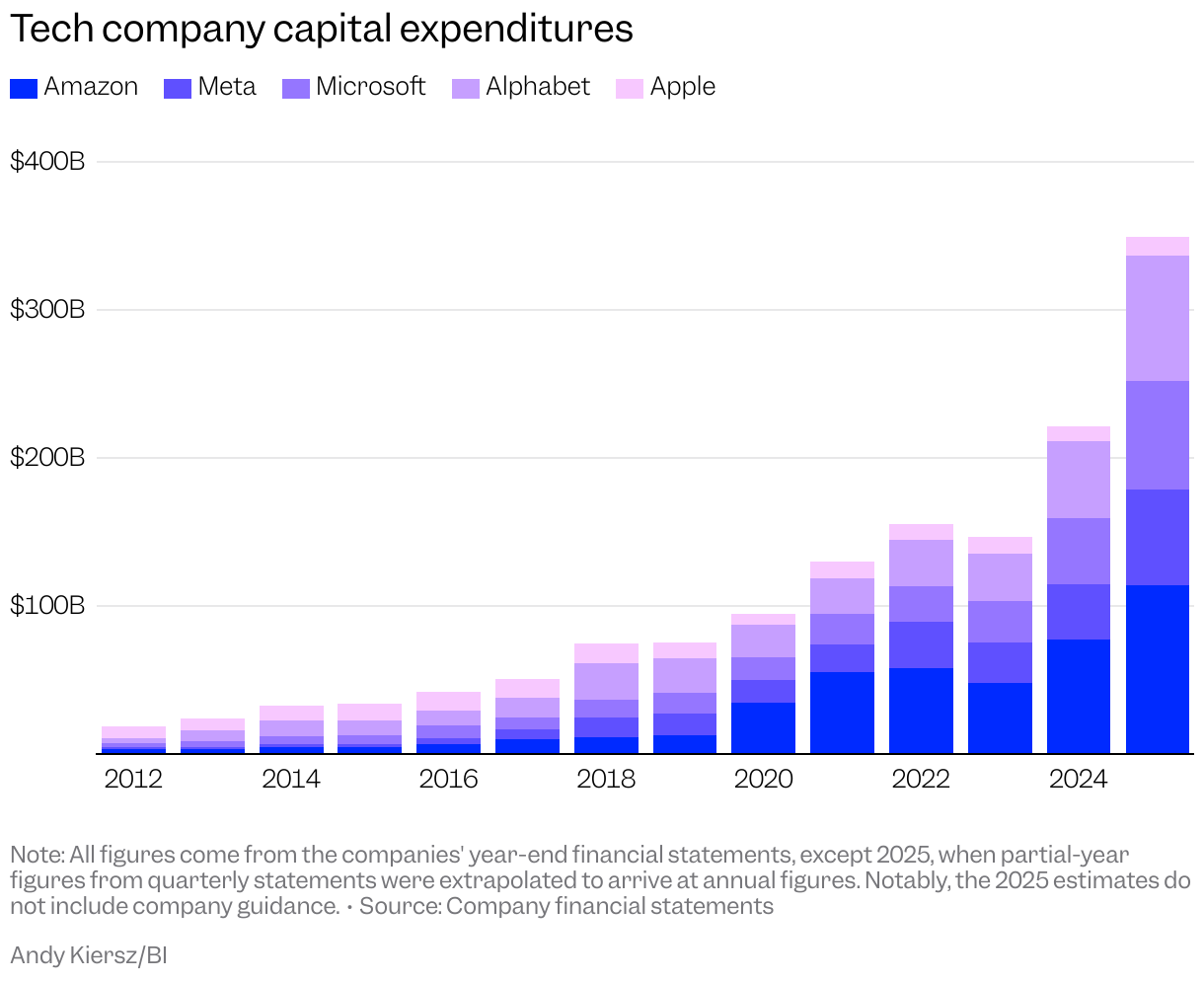
- On earnings calls this week, Big Tech companies reported significant AI spending.
- Each said the spending spree will continue into 2026 and be even bigger than previously reported.
- Some investors are concerned about the risks of an AI bubble.
Big Tech’s AI gold rush isn’t slowing down— it’s getting more expensive.
Amazon, Google, Meta, and Microsoft all opened their wallets wider than ever this quarter, logging record-breaking capital expenditures on AI chips, servers, and data centers.
Microsoft was the top spender at nearly $35 billion, narrowly beating Amazon. Meta CEO Mark Zuckerberg said the company could increase its long-term asset spending, or capital expenditure (capex), by as much as 24% next year. Each company said it planned to spend even more on capex going forward.
A few recent deals exemplify this trend. Amazon this week opened an $11 billion data center in Indiana, part of its massive AI supercluster called Project Rainier, and said it would spend $5 billion on data centers in South Korea. Microsoft recently joined a consortium of investors, including BlackRock, Nvidia, and Abu Dhabi’s MGX, to buy 50 data centers in the US and Latin America Aligned Data Centers for $40 billion. Aligned operates 50 data centers in the US and Latin America.
Even Apple, a notoriously restrained spender compared to the other hyperscalers, told investors that it expects capital expenditure (capex) spending to increase in the next fiscal year.
Investors are watching closely: companies showing early AI payoffs, like Google, are being rewarded, while others — like Meta — are running out of time to prove the spending spree is worth it.
“After all the expensive hires and the capex ramp, Meta’s grace period for showing investors something on the non-core AI side is nearly up,” Bernstein senior analyst Mark Shmulik said Wednesday in a research note.
The question for investors: which of these giants can turn that spending into actual AI returns — and which are just building costlier foundations for the future?
Matthias Balk/picture alliance via Getty Images
Reuters
Chris Jung/NurPhoto via Getty Images
Jonathan Raa/NurPhoto via Getty Images
Read the original article on Business Insider

The sun will soon appear to rise earlier in the morning and set earlier in the evening for most people in the U.S., as Daylight Saving Time ends and Standard Time begins again. But for millions of Americans whose states don’t observe Daylight Saving Time, the clocks will remain unchanged.
Other states are trying to stay in Daylight Saving Time permanently. They have yet to secure the right to do so, however, and will once again have to fall back an hour this weekend as the controversial cycle rolls on.
[time-brightcove not-tgx=”true”]
Here’s what to know about Daylight Saving Time and where states—and President Donald Trump—stand on the issue.
When do the clocks go back this year?
Daylight Saving Time will end on Nov. 2 at 2 a.m. local time this year, meaning that at that time, the clocks will shift backward by one hour. After that, the sun will appear to rise earlier in the day and set earlier in the evening.
Standard Time will continue until Daylight Saving Time starts again next March, when the clocks will move forward by one hour.
The twice-a-year practice of changing the clocks was permanently established with the Uniform Time Act of 1966. The law allows states to exempt themselves from Daylight Saving Time if they choose to do so, but it doesn’t allow states to “independently change time zones or the length” of Daylight Saving Time.
Seven years after the law was passed, the U.S. briefly enacted year-round Daylight Saving Time under President Richard Nixon in 1973 in an effort to reduce energy consumption amid an energy crisis. But Congress voted to return to Standard Time just eight months later.
Read more: The U.S. Tried Permanent Daylight Saving Time Before. Here’s What Happened
What states don’t participate in Daylight Saving Time?
Hawaii and most of Arizona don’t observe the practice; instead, they use Standard Time year-round.
The U.S. territories of American Samoa, Guam, the Northern Mariana Islands, Puerto Rico, and the U.S. Virgin Islands also don’t observe Daylight Saving Time.
What states are trying to make Daylight Saving Time permanent?
In recent years, lawmakers in states across the country have expressed support for making Daylight Saving Time permanent. Doing so would mean advancing the clocks forward an hour for the whole year, so that the sun would appear to rise and set an hour later in both the summer and in the winter.
A bipartisan bill called the Sunshine Protection Act, which would have made Daylight Saving Time permanent, has been introduced in Congress a few times in recent years. It was reintroduced earlier this year by Republican Sen. Rick Scott of Florida, but has since stalled.
Several states—including Alabama, Colorado, Delaware, Florida, Georgia, Louisiana, Mississippi, Oklahoma, and Oregon—have passed legislation to make Daylight Saving Time permanent. But because those laws are contingent on congressional approval, the year-round observation isn’t currently implemented in any state so far.
Read More: How Daylight Saving Time Could Change Under Trump
What has Trump said about Daylight Saving Time?
In 2019, Trump expressed support for making Daylight Saving Time permanent, tweeting, “Making Daylight Saving Time permanent is O.K. with me!”
But since then, the President has suggested ending the practice altogether. In December 2024, about a month after he was elected for a second term, he posted on Truth Social, “The Republican Party will use its best efforts to eliminate Daylight Saving Time, which has a small but strong constituency, but shouldn’t! Daylight Saving Time is inconvenient, and very costly to our nation.”
In March, Trump called Daylight Saving Time “a 50-50 issue,” saying that people are divided on it, according to Reuters.
Spain’s Foreign Ministry will host a secret meeting of the “coalition of the willing” in Madrid on November 4 to discuss support for Ukraine.
According to reports, delegates from 35 countries are expected to attend.
Participants have been banned from using phones or sharing any… pic.twitter.com/sK7yLnzkpR
— Visegrád 24 (@visegrad24) October 31, 2025