
Antisemitic activist Linda Sarsour isn’t just playing a big role in Zohran Mamdani’s NYC’s mayoral campaign — she’s been a political mentor and friend of the silver-spoon socialist for nearly a decade.
Day: October 25, 2025
Courtesy of the author
- Growing up in the age of social media, I thought it determined my worth.
- Today, the same pressures of posting still exist in different ways.
- I limit my time on social media to escape the noise.
As a Gen-Zer, I grew up in the early phases of social media. I went through the trends, posted silly music videos with my sister on Vine (pre-TikTok), and, of course, I took many duck-face selfies and dog-ear filtered photos on Snapchat.
I tried so hard to fit in with the aesthetic of white borders around photos, collages, and throwback Thursdays. I took mirror selfies of my #OOTD before school and snapped artsy pictures of my mocha latte at the popular coffee shop. My VSCO app was always open, adding heavy filters and removing the blemishes I fixated on that only I noticed.
Now that I’ve gotten older, I’m carving out time away from social media to do things I love.
I was obsessed with how I looked on the screen
In high school, I was obsessed with my follower count, as were many of my peers. Likes, comments, and shares occupied my mind.
If a post didn’t get a like within two minutes, I’d delete it and try again, often asking friends to like it and comment just to keep up with appearances. When I lost a follower, I’d look at an app to see who it was. I was constantly refreshing, hoping to get more than 100 likes in an hour.
I drove myself crazy.
My teen self, like many others, was constantly on the apps. Who’s hanging out with whom? Whose house did I not get invited to? Where’s the big party after the homecoming dance?
It left for sad nights and the pressure to appear a certain way on social media for intangible likes.
The pressure of social media follows into adulthood
Today, these same pressures continue to manifest in various ways as social media evolves and grows daily. Now, instead of focusing on likes, I get stuck in the endless scroll: seeing people my age move out of their parents’ homes, get engaged, land dream jobs, or travel to extravagant places and resorts.
This creates comparison and self-doubt about what I am doing wrong, when the answer is nothing, I’m on my own path. However, social media makes it easy to compare myself and feel like I’m falling behind.
I try to set boundaries for my social media usage
As social media has changed over the years and apps try to suck us in for longer and longer, I have to change, too. I’ve learned to try to resist the pressures these apps create. During the week, I carve out time away from the screen, focusing on things that make me feel good about myself.
After work, I make time to attend my favorite group exercise classes at the gym, followed by a walk in the park, where I take in the natural surroundings. I only use my phone for music, not scrolling while walking.
I block out time for writing by putting my phone away to eliminate any outside noise. I turn off all notifications, enjoying the time away from the pings.
When going out with my family and friends, instead of constantly reaching for my phone to snap an Instagram story, I try to remain present, engaging in meaningful conversations and creating memories that will last a lifetime, rather than something for a random person to click on for a millisecond.
I’m not perfect
Instead of having the mindset of proving my self-worth to a bunch of followers, I’ve shifted to posting what I want to post, and it makes me feel good.
Now, I enjoy posting in ways that help me establish more connections with people in my career field — I seek to engage in meaningful conversations instead of just scrolling or chasing clout. I don’t hesitate to post something that I’m proud of accomplishing and disregard what others’ opinions may be.
Getting wrapped up in social media can be challenging, especially as my full-time job is as a social media and marketing manager. It’s easy to start getting into your head and begin comparing yourself to others.
I often get trapped and start doomscrolling. And, trust me, I still do love posting a nice sunset or my favorite pasta dish at a restaurant. However, maintaining a mix of a positive mindset and simple practices to avoid the noise helps prove that my self-worth isn’t defined by likes and follows.
Read the original article on Business Insider
On 28 July 2025, as the skirl of bagpipes echoed across the windswept greens of President Trump’s Turnberry golf resort, two world leaders met under the Scottish flag. U.K. Prime Minister Keir Starmer and U.S. President Donald Trump gathered for “wide-ranging talks” on trade and global conflicts — yet it was the sound of a Scottish pipe band that first captured attention. For President Trump, whose mother was born in the Outer Hebrides, the music carried a personal resonance.
The bagpipe, long a symbol of Scotland’s spirit, continues to speak across generations and continents — from clan gatherings and state ceremonies to moments of diplomacy. Its sound is unmistakably Scottish: bold, mournful, and proud. Yet across the ancient world, far beyond the Highlands, other peoples once drew the same haunting tones from leather and reed — among them the nomads of what is now Kazakhstan.
Echoes from the East
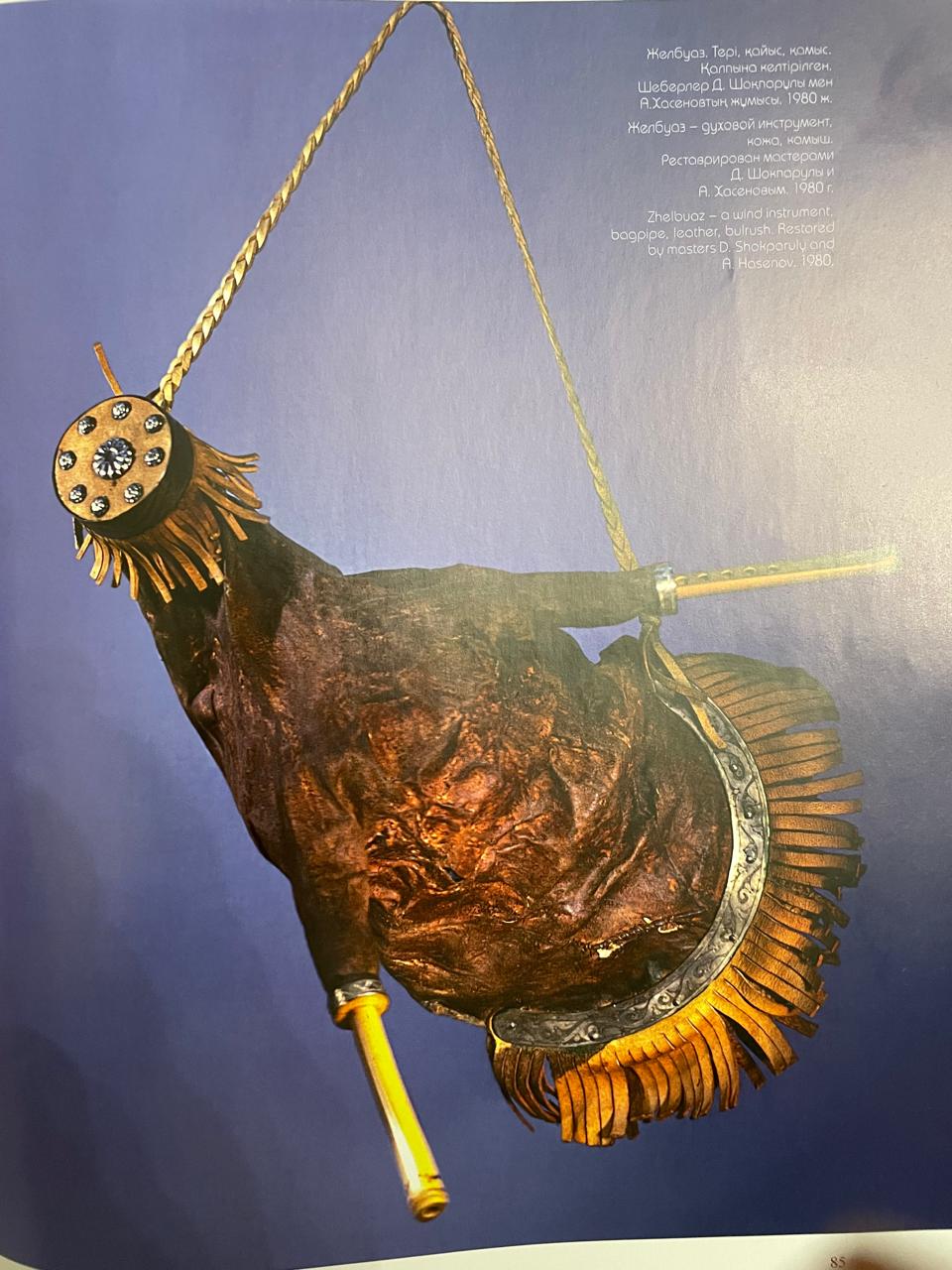
Centuries before the first Highland marches, nomadic Turkic peoples were playing an instrument remarkably similar in design — the zhelbuaz. Crafted from goat or sheepskin and fitted with two or more reed pipes, it produced the same soulful harmony that defines the modern bagpipe. When filled with air and played from horseback or during ceremonies, it created a sound that was at once haunting and powerful, much like the music that still moves crowds today.
As the people of the Central Asian steppes were largely nomadic for most of their history, there is scant hard evidence. However, early scholars described the zhelbuaz (or mes-syrnai) as an ancient wind instrument made from a single piece of animal skin or stomach. Al-Farabi wrote of a “wineskin flute” among the Turkic tribes, and the Chinese traveler Wen Sun, visiting the Orkhon region in the 7th century, reportedly recorded a Turk playing a “leather instrument with two pipes, whose sound deepens the sadness of the mourners.”
The Journey Westward
Over centuries, the idea of the air-filled reed instrument migrated westward — first through trade and migration, and then through cultural contact. Variants appeared in Eastern Europe: the duda in Poland, the tulum in Azerbaijan, and the musette in France. Linguists note that modern terms such as duu (meaning “song” in Mongolian) and düdük (meaning “whistle” in Turkish) suggest a shared onomatopoetic pattern for wind instruments and vocal sound across Eurasia, hinting at, though not proving, a linguistic thread connecting these distant traditions.
But it was in Scotland that the instrument found its fullest voice. There, in the hands of Highland clans, it became more than music — it became identity. The Great Highland Bagpipe emerged as a call to arms, a hymn of remembrance, and a symbol of a people’s endurance. Its power lies not just in its sound, but in what it represents: honor, courage, and belonging.
Image: Ykhlas Museum of Folk Musical Instruments
The Zhelbuaz Remembered
In Kazakhstan, the zhelbuaz gradually disappeared from everyday life, its haunting voice surviving only in oral memory and museum collections.
Today, musician Abzal Arykbaev of the Turan Ethno Folk Band describes the zhelbuaz’s distinctive power: “The unique feature of this instrument is that it allows you to produce two different tones simultaneously.”
Samat Malimbay, conductor, composer, and senior lecturer at the Kazakh National Pedagogical University, told The Times of Central Asia, “The instrument is quite difficult to make. Nomads who were engaged in cattle breeding made it from the skin or stomach of a lamb or goat, while residents of coastal areas made it from the stomach of a seal. The skin is carefully cleaned of wool, soaked, softened, stretched, and dried. Then, holes were made in two places for sound, into which reed pipes were inserted. After installing the pipes, the edges of the instrument were carefully processed, and the surface was painted with natural paint made from lichen.
“Usually, the instrument is 65-70 cm long and 30-35 cm wide, and is also known by the names “zhel-kobyz,” “kuyk-kep,” “mes-kobyz,” and “zhel-saz.” Since the shape of the instrument resembles the swollen udder of a pregnant cow, it was named zhelbuaz (literally “inflated with air”).
“There is a scientific opinion that the Kazakh kobyz is the ancestor of instruments such as the violin, viola, and cello. It is believed that the kobyz was brought to Europe by the Huns. Therefore, it is possible that the zhelbuaz could have also come to Europe with the Huns and, perhaps, became the ancestor of the Scottish bagpipes.”
According to Malimbay, the zhelbauz was first introduced into an orchestra by conductor and composer Nurgisa Tlendiev. In 1982, when creating the Otyrar Sazy folk and ethnographic orchestra, Tlendiev ordered a zhelbauz in Latvia and then adapted Ykylas’s kuy (national instrumental piece) “Erden” for it.
“Unfortunately, there are currently no people left who know how to play this instrument,” Malimbay told TCA. Nurgisa Tlendiev once taught a musician to play it, but that person has since passed away.”
Kindred Spirits Across the Steppe and the Glen
That same dual resonance of the zhelbauz — one tone steady and grounding, the other soaring and expressive — finds an echo in the Great Highland Bagpipe, a reminder that across continents and centuries, human creativity has discovered remarkably similar ways to voice emotion through sound.
In Scotland, the bagpipe represents independence, strength, and unity — a music that has rallied clans, celebrated victories, and endured through centuries of change. Its sound belongs to the mountains and the marches, to a people who have never forgotten who they are.
In Kazakhstan, the ancient zhelbuaz spoke to a similar spirit. The nomadic peoples of the steppe were unbound, self-reliant, and resilient — survivors in vast, untamed lands. While evidence of the zhelbuaz’s use among early nomads is limited, its rediscovery evokes that same ethos of endurance and freedom. It is no surprise that they, too, would have cherished an early form of the bagpipe: an instrument capable of capturing both the loneliness and the freedom of life beneath the endless sky.
Separated by geography but united by instinct, these two traditions reveal the timeless truth that a human heart filled with courage and longing produces the same music everywhere.