
Semey, Kazakhstan – In the windswept, seemingly infinite steppe of eastern Kazakhstan stands a city with a dual, haunting legacy. It is a place where one of the world’s literary giants plumbed the depths of the human soul, and where, a century later, humanity sought to master the power to extinguish itself. This is Semey, formerly Semipalatinsk, a city whose soil is steeped in the memory of both Fyodor Dostoevsky’s exile and the Soviet Union’s atomic ambition.
For Fyodor Dostoevsky, one of Russia’s most celebrated writers, Semey was not a destination of choice but of punishment. Arrested in 1849 for his involvement with the Petrashevsky Circle — a group of intellectuals who read and discussed banned political texts — Dostoevsky was sentenced to death, only to be spared at the last moment in a mock execution ordered by Tsar Nicholas I. His sentence was commuted to four years of hard labour in the Omsk fortress, followed by compulsory military service in Semipalatinsk.
Arriving in 1854, Dostoevsky spent nearly five years in Semipalatinsk, a provincial outpost on the Russian Empire’s edge, where exiles, soldiers, and bureaucrats mingled with Kazakh nomads and merchants. Though his official role was that of a soldier in the Siberian Line Battalion, his time here marked a critical period of transformation — politically, spiritually, and literarily.
Semey offered isolation, but also introspection. Deprived of literary contact, Dostoevsky was forced inward. His exposure to suffering — in prison, in exile, and his struggles with epilepsy — sharpened the moral and psychological vision that would later define Crime and Punishment, The Idiot, and The Brothers Karamazov. In letters from this time, he describes long walks through the barren steppe and his growing fascination with the Kazakh people, whose customs and resilience left a lasting impression.
During his years in Semey, Dostoevsky also began to reengage with the intellectual world. Thanks to the leniency of local officials, he was able to read, write, and eventually re-enter literary circles. It was here he completed Uncle’s Dream and The Village of Stepanchikovo, and began work on Notes from the Dead House, a fictionalised account of his time in prison that marked a decisive shift from romanticism to the raw psychological realism for which he became renowned.
Despite its remoteness, Semey in the 1850s was not without its cultural encounters. Dostoevsky formed a lasting friendship with Chokan Valikhanov, a Kazakh nobleman, ethnographer, and military officer, whose liberal views and deep knowledge of Central Asian culture helped broaden Dostoevsky’s perspective on the empire’s outer subjects. Their conversations influenced Dostoevsky’s thinking on race, empire, and the spiritual dignity of non-Russian peoples — ideas that subtly permeate his later works.
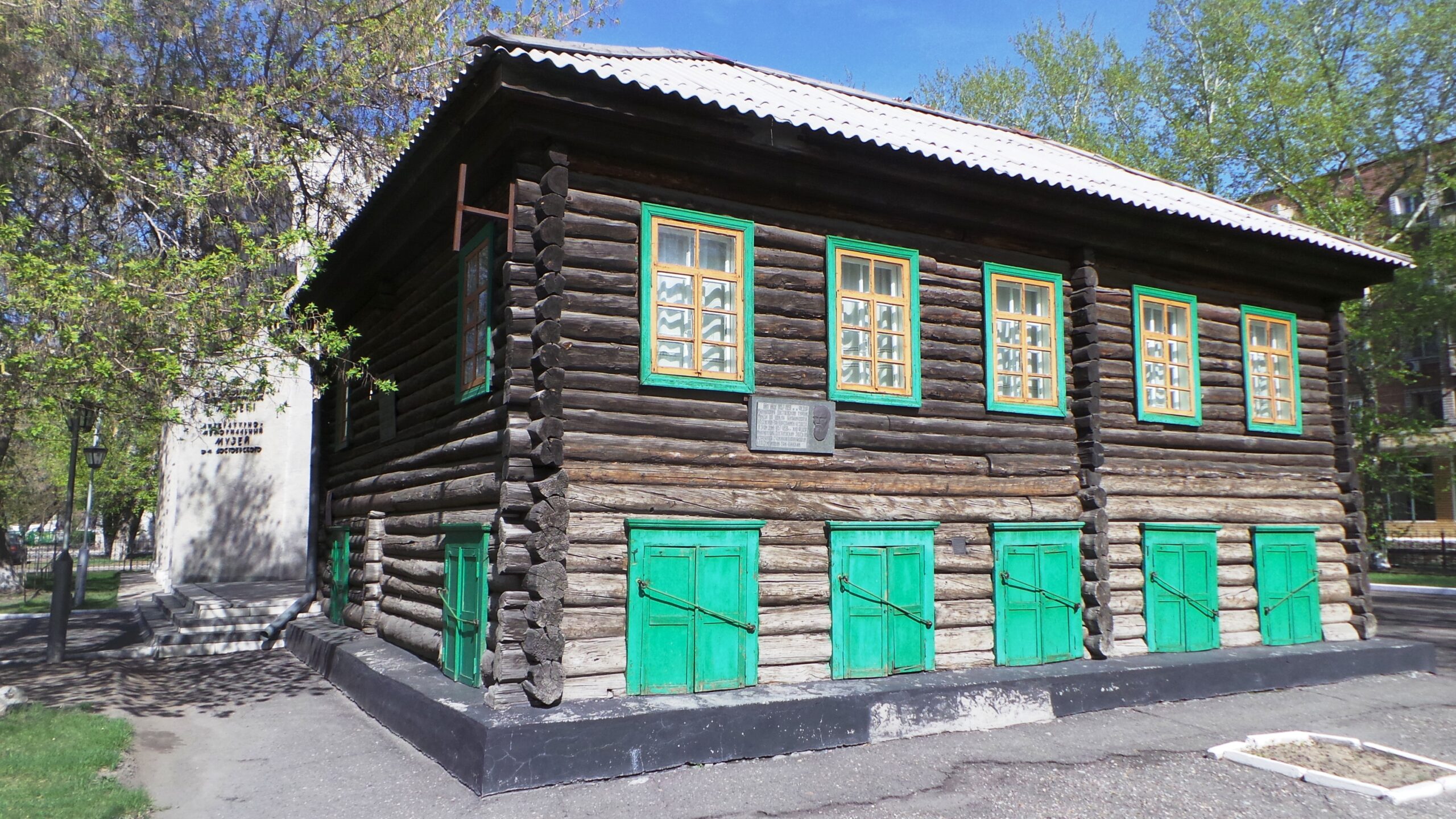
Dostoevsky’s House in Semey; image: Yakov Fedorov
Today, Dostoevsky’s former house still stands in Semey, converted into a museum dedicated to his life and writings. Modest in size but rich in atmosphere, it preserves manuscripts, personal letters, and portraits that evoke the introspective solitude of his exile. A statue of the writer stands in a quiet square, facing the steppe — perhaps as he once did, searching for meaning beyond the horizon.
Yet Semey is also haunted by another legacy: from 1949 to 1989, it lay just 150 kilometres from the Semipalatinsk Test Site, the epicentre of Soviet nuclear experimentation. More than 450 nuclear tests were conducted there, leaving environmental and genetic scars that still shape the city’s identity today. The juxtaposition is startling: a town that once reformed a writer who peered into the abyss of human suffering later became the stage for mankind’s flirtation with annihilation.
In this strange confluence of literature and atomic history, Semey emerges not as a forgotten frontier but as a place that reflects the extremities of human ambition and resilience. It remains, in many ways, a Dostoevskian city, fraught with suffering, yet never fully devoid of redemption.