
On the sunlit shores of Lake Issyk-Kul this August, Kyrgyzstan played host to leaders from across the Eurasian Economic Union (EAEU). On August 14-15, officials from Armenia, Belarus, Kazakhstan, and Russia descended on the resort town of Cholpon-Ata for a meeting of the Eurasian Intergovernmental Council, accompanied by ceremonies to mark a decade since Kyrgyzstan joined the Moscow-led economic bloc.
The Kyrgyz government issued a commemorative stamp to celebrate the anniversary, while the guest of honor, Russian Prime Minister Mikhail Mishustin, arrived with pledges of deeper integration. Rosatom, Moscow’s nuclear agency, signed agreements to build Kyrgyzstan’s first wind farm near Issyk-Kul, while the union’s five governments also agreed to recognize each other’s digital documents, and talks continued on a long-awaited gas union.
Mishustin also caused a stir on social media by addressing the Kyrgyz honor guard in their own language. The words “Salam Asker” (hello, soldiers) were enough to draw appreciation from a Kyrgyz society unused to hearing Russian politicians use any language but Russian in its former colonies.
The flattery was all part of the choreography: in return, Kyrgyz government officials and state media fell in line to proclaim the benefits of EAEU membership.
But have these benefits been worth it? Or has the EAEU merely tethered Bishkek to a partner whose grip is more suffocating than supportive?
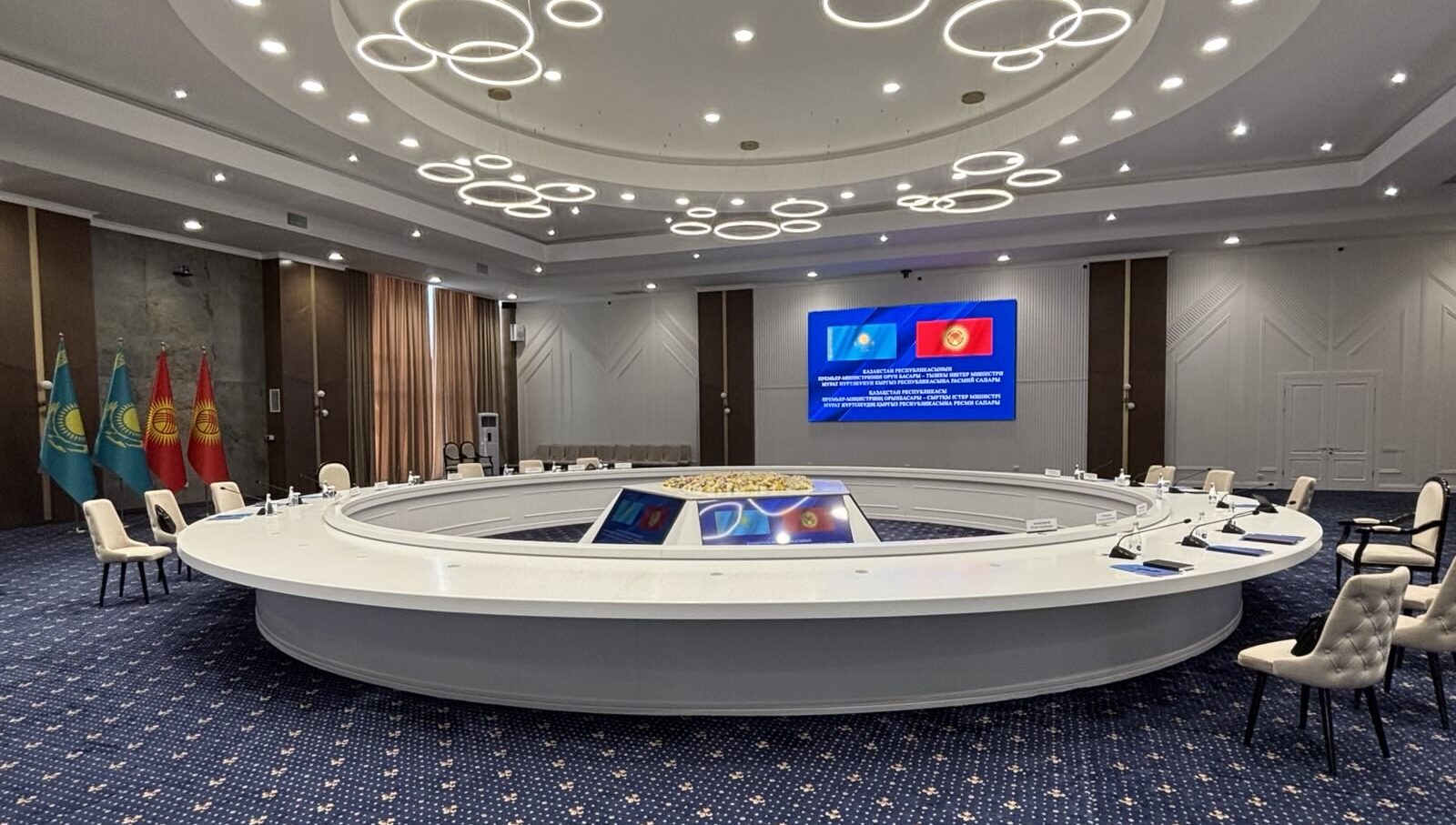
The Conference Hall at Cholpon-Ata, where the council meeting took place; image: Joe Luc Barnes
The Case for the Union
Kyrgyz officials are keen to emphasize the upsides. In an interview with state mouthpiece Slovo.kg, former economic minister Arzybek Kozhoshev said that joining the bloc had eased conditions for Kyrgyz migrant laborers in Russia and Kazakhstan.
“With the accession of the Kyrgyz Republic to the EAEU, the conditions of stay and work of citizens of the Kyrgyz Republic in other EAEU countries have changed significantly,” Kozhoshev said, highlighting simplified entry, no requirement to take a Russian language exam, equal access to health insurance, and even the right to draw pensions on par with local workers.
For a country where remittances have accounted for around 25% GDP over the past decade, these measures are not insignificant. Kyrgyz drivers, once barred from operating commercial vehicles in Russia, now enjoy full rights. Digital labor platforms like Work Without Borders make it easier to find jobs, and migrant workers in Russia pay the same flat 13% tax as local workers.
In short, for the hundreds of thousands of Kyrgyz toiling in Moscow, Novosibirsk, and Almaty, the EAEU has meant fewer hurdles and more predictability. It’s worth bearing in mind that other potential labor destinations, such as Korea, the United States, or the European Union, are not handing out hundreds of thousands of visas to Kyrgyz citizens every year.
Kremlin officials have also stressed that Kyrgyzstan pays lower tariffs on Russian gas – only $150 per 1,000 cubic meters, due to its EAEU membership. That said, given Russia’s current oversupply of gas with the closure of the European market, this is not as beneficial as it once was. Neighboring Uzbekistan is not an EAEU member and has been paying around $160 per 1,000 cubic meters since 2023.
The Kyrgyz government is also keen to link the country’s recent economic growth to EAEU membership. In his interview with Slovo, Kozhoshev unleashed a blizzard of statistics in an attempt to correlate recent economic growth with union membership.
“The average annual GDP growth in the period 2015-2023 is 3.9%, nominal GDP growth has increased threefold, namely from 401.0 billion som to 1.2 trillion som. Budget revenues increased 3.3 times to 391.9 billion som. GDP per capita is equal to $1,163 in 2015, and $1,969in 2023, an increase of 1.7 times,” he said.
While this argument can be questioned (are there not other factors which have led to growth?) it seems EAEU membership has offered a significant tailwind in recent years, particularly with Kyrgyzstan benefiting from what might be called “sanctions arbitrage”.
Unsanctioned Growth
Since Russia invaded Ukraine and the subsequent Western sanctions, Kyrgyzstan has become a significant re-export hub for Moscow. In the auto sector, for example, with Western companies refusing to sell to Russia, entrepreneurial Kyrgyz businesses have been importing BMWs from Germany or Toyotas from Japan before selling them on to the Russian market for a healthy profit.
Many Russians in search of a new vehicle have turned to China, and even here, Kyrgyzstan has benefited. Upon accession in 2015, Bishkek negotiated temporary exceptions to EAEU customs duties on vehicles. By 2023, these duties were 15%, compared to up to 25% in Russia, in addition to a lower rate of VAT. These two factors led to the widespread funneling of Chinese car purchases through Kyrgyzstan. This loophole was closed to an extent in 2024, with the Kremlin putting pressure on Bishkek to raise its customs duties, but that did not stop an estimated 60,000 Chinese vehicles from being purchased through Kyrgyzstan in early 2023 alone.
Cars are just one example; the dramatic rise in the import and export of sanctioned dual-use goods has led many to conclude that Kyrgyzstan has been one of the key enablers of Russia’s war machine.
The World Bank estimated that the VAT alone from the “transit trade” contributed around KGS 25.2 billion ($300 million) to the government coffers in 2022, and KGS 37.9 billion ($433 million) in 2023, the latter figure representing around 3.3% of the country’s entire GDP.
While critics call it sanctions-busting, Bishkek sees it as opportunistic trade. In June 2023, the Kyrgyz government changed the way it records export statistics in an attempt to mask some of the more brazen deals, but this has not prevented numerous sanctions monitoring visits by EU officials and sanctions on several banks and companies by the United States.
However, from an economic perspective, the fact that no severe penalties have materialized has made this somewhat of a bonanza period for the Kyrgyz economy, and all linked to its customs-free EAEU membership.
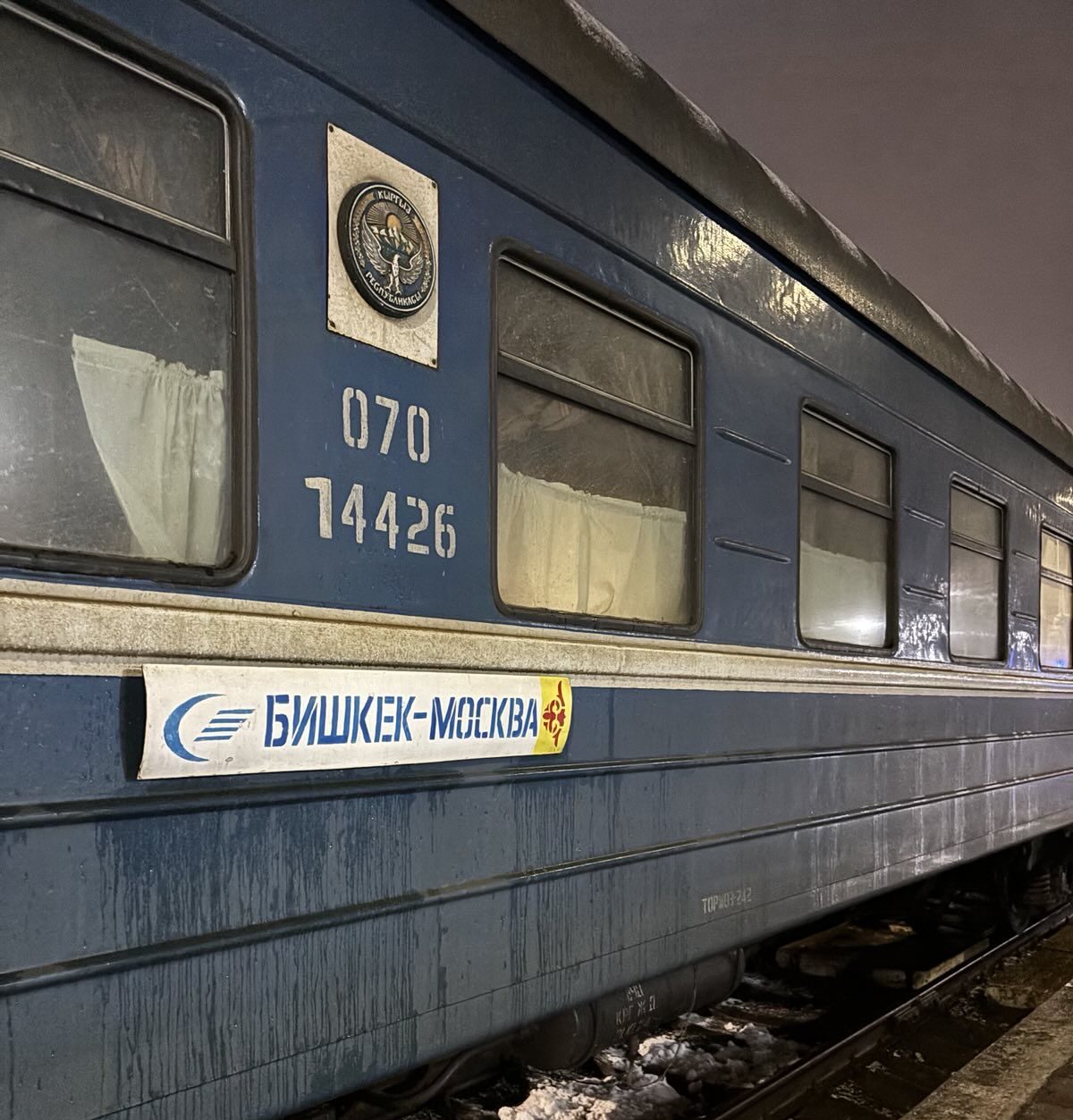
A Bishkek train bound for Moscow; image:: Joe Luc Barnes
The Limits of Integration
There are, nevertheless, some serious flaws in the architecture of the union. First, the migrant question cuts both ways. Access to the Russian labor market may be easier, but in some ways, that is a disadvantage: some unscrupulous employers prefer to hire cheaper illegal migrants or expect Kyrgyz citizens to work for less, due to the extra costs and bureaucracy involved with taxes and social security payments.
Kyrgyz workers also face racism, police harassment, and sudden deportations. A 2024 poll by the Levada Center showed that 56% of Russians believed people from Central Asia should only be allowed to enter Russia temporarily.
Such stigma has fueled periodic campaigns targeting Central Asian migrants by the Russian authorities. Purported EAEU benefits matter little to those forced to crawl half-naked across the floor of a Moscow bathhouse by overzealous immigration police.
The long-term economic benefits of migrant labor are also questionable – while they bring in quick cash, it means families are divided, children grow up with absent parents, and migrants can find their professional development stymied for the short-term gains from seasonal labor.
Second, the principle of a single market is often abandoned when its larger members seek to exert political pressure. Moscow and Astana will often employ “phytosanitary failings” or “pipeline maintenance” for throttling each other’s exports, while Kazakhstan has a habit of delaying crossings over the Kyrgyz border, sometimes even closing it completely, as it did most famously in 2017, jamming Bishkek’s trade overnight. Such actions undermine the bloc’s founding promise as a free trade union.
Finally, the union acts as a geopolitical bind. By serving as a conduit for sanctioned goods, Bishkek risks alienating Western partners and deepening its reliance on Russia, while also limiting the prospects of deeper integration with its other neighbors. Uzbekistan, Tajikistan, and, most importantly, China, are all outside the bloc, and while the former two have long flirted with joining, there is little sign of a trade deal in sight. Should any future deals materialize, they are likely to serve the interests of Russia, the EAEU’s largest member.
A Double-Edged Decade
On balance, the EAEU has delivered tangible gains: easier migration, expanded trade, and a huge boost to GDP and tax revenues through re-exporting sanctioned goods to Russia. For a landlocked country of seven million, such outcomes are not trivial. As such, dismissing the EAEU as a project that only benefits Moscow overlooks much of the nuance.
Nevertheless, Kyrgyz government policy could be argued as short-sighted: re-exports that may be lucrative today but could trigger headaches tomorrow if Western scrutiny intensifies, or indeed crumble to dust if sanctions on Russia are lifted.
Bishkek’s EAEU commitment has left Kyrgyzstan hanging onto the coattails of Moscow’s rollercoaster economy. This exposes the country to negative shocks, such as the oil price collapse of 2014, as well as the current sanctions-busting benefits. For now, Kyrgyzstan is booming, but what lies next on this wild ride is largely out of Bishkek’s control.