
Categories
Selected Articles

Ukraine’s drone war is accelerating

Spread the love

Ukrainian soldier using VR technology.
A drone pilot from the 65th Brigade works at a training site in the Zaporizhzhia region.

This story originally appeared in Politico Magazine and appears on Business Insider through the Axel Springer Global Reporters Network.

NEAR KHARKIV, Ukraine — The Ukrainian soldiers couldn’t believe what they were seeing. One of their aerial drones had spotted two Russian soldiers trapped in a dugout.

“Our main mission was to destroy the shelter along with the enemy,” said Vladyka, the commander of the drone crew in the 3rd Assault Brigade, in an interview with POLITICO Magazine at a hidden training site 20 miles from the front lines in eastern Ukraine. Working closely with first-person-view (FPV) drone pilots, the team launched a ground-based kamikaze drone rigged with three anti-tank mines directly into the tree line that concealed the enemy’s dugout. “The blast was powerful,” Vladyka, 35, said, “a very strong explosion.”

As the team loaded a second ground drone with explosives, the Russians suddenly emerged from the entrance of their hideout. They had scrawled a message in blue Cyrillic letters on a makeshift white poster and were frantically waving it skyward at the hovering drone: “We want to surrender.”

That’s when the 3rd Brigade recorded a video of something that they believe had never happened before: the first successful assault carried out exclusively by robots.

“We flew up to them and signaled them to follow us,” said one of the UAV operators who goes by the call name Major. “They understood everything right away.” The Russians followed the aerial drone across open ground toward Ukrainian lines, where they were taken into custody. “Our comrades put them face down on the ground and took them,” Major, 33, said. The 21-year-old operator of the ground robot (call sign LaCoste) said he was still surprised by how quickly the Russians made the decision to surrender. “Although I understand their motivation: a small vehicle pulls up to them and there’s a bunch of explosives. Enough to destroy a dugout,” he said.

A drone lands.
A drone, flown by the 65th Brigade, is seen at a training site in the Zaporizhzhia region.

The rapid advancement and widespread use of inexpensive observation and strike drones — in the air and on the ground — have transformed warfare in Ukraine since 2022 and is one of the biggest reasons Ukraine has managed to bring its far larger adversary to a stalemate. What is surprising, however, is how the pace of innovation has continued — yielding small tactical breakthroughs like the soldiers’ surrender and also technological leaps that have fundamentally altered battlefield tactics across the entire war zone. In recent months, the so-called kill zone — the zone of sustained and lethal exposure to enemy fire — has expanded far beyond the range of a rifle or a mortar. Soldiers on both sides are in constant danger when they are as far as six to nine miles from the contact line. Packs of inexpensive kamikaze drones — each barely a half foot across and packing the explosive punch of a grenade or land mine — now hunt virtually every type of target: fortified positions in tree lines, armored vehicles, and individual infantrymen. Drones are responsible for a staggering 60 to 70% of killed and wounded soldiers in Ukraine, according to combat medics. The defense on both sides is adapting as well. Entire stretches of frontline streets are now draped in netting to shield against aerial attacks. This expansion of the kill zone has depopulated near-frontline cities like Kostiantynivka in eastern Ukraine. Many residents have been killed and even more have fled, dwindling a pre-war population of 70,000 to only a few thousand who endure dozens of daily Russian drone strikes.

That expansion has also had severe military consequences. Access roads are under constant surveillance and attack by drones, making traditional resupply and the transport of troops to frontline positions nearly impossible in some areas. Infantry and assault units on both sides operate primarily in groups of 10 people maximum, and large-scale mechanized advances have become rare due to devastating losses inflicted by drone strikes. As a result, many tasks that were once carried out by soldiers are now done by unmanned devices. According to Ukrainian media reports from March, the Ministry of Defense plans to deliver 15,000 ground robots to the battlefield by the end of this year — a severalfold increase compared to the previous year. Some brigades also independently order ground drones from manufacturers using donated funds from civilians — a practice that has become common in Ukraine.

The drone crew of the 3rd Assault Brigade, from left, LaCoste, Major and Vladyka, stand at a hidden training site 20 miles from the front lines in eastern Ukraine.

For Vladyka’s unit of the 3rd Assault Brigade, robotic systems have become essential to maintaining their logistics. “Even basic tasks like delivering water, bringing ammunition, evacuating wounded or fallen soldiers have become too risky to carry out manually,” the commander says, as he steers a Targan 2K ground drone — basically, a large four-wheeled storage bin — across a field in eastern Ukraine using a remote controller. Its range is about 9 miles on rough terrain, with a top speed of 7 miles per hour. His unit mainly uses this robot for evacuation missions (it can carry one man), but it can also transport large aerial drones, including quadcopters and “Vampire” hexacopters (six rotors). Unmanned resupply operations take place not only on the ground, but also through the air. This summer, POLITICO Magazine accompanied soldiers from the 12th Brigade on a mission near Kostiantynivka, where they used a $25,000 Heavy Shot drone to fly packages of ammunition and water to encircled comrades near the Russian-occupied town of Toretsk. After several successful flights, however, Russian FPV drone operators spotted the aircraft and destroyed it directly over the Ukrainian position.

If the enemy detects us, we … are the number one target for them.Call sign Major

The use of unmanned systems has become existential for Ukraine — not least because of its limited resources in the fight against a much larger country with four to five times its population. “The goal is to preserve lives, because our human resources are limited. That’s why we focus on this,” Vladyka said. Mine-laying and demining — for the first years of this war the domain of trained engineers and sappers working just behind the front — have become nearly impossible for humans under the constant threat of drones. The robots use a claw at the end of an extendable arm to pluck mines from the ground. “We’re putting a lot of effort to make their work easier and, most importantly, to prevent our people from getting wounded or killed just because they have to enter dangerous zones,” Vladyka said. That’s why his unit is investing heavily in automation. Earlier this year, operators from the Khartia Brigade reported they deployed 180 mines in an unmanned operation, allowing them to secure the area against Russian assaults.

This also applies to unmanned offensive operations — like the assault that forced the two Russian soldiers to surrender. Recently, Vladyka, the 3rd Assault Brigade’s commander, said his unit pulled off a similar coup when one of its ground drones stole a Russian PKM 7.62 mm machine gun directly from an enemy position. “We got the coordinates, got a photo, went and took it away” before the Russians knew what had happened, he said. The crew has kept the machine gun as a battlefield trophy.

Although unmanned systems are operated remotely, the belief that operators like him work in safety is a misconception, Major said. “Actually, our job is no less dangerous than the infantry, although we are a few kilometers farther away,” he explains. “If the enemy detects us, we … are the No. 1 target for them.” As soon as they are detected, his crew is hit with whatever the Russians can throw at them — including, most recently, a heavy KAB glide bomb. “So, is it dangerous to perform our duties?” Major said. “Always, always.”

A secret meeting with ‘Achilles’

Ukraine’s elite drone commanders rank high on Russia’s most wanted list. To meet one, I was given a set of coordinates that led into an abandoned patch of forest in eastern Ukraine. After a 20-minute wait, a dusty pickup truck appeared, flashed its lights briefly — a silent signal to follow. A few moments later, the vehicle stopped, and a tall, broad-shouldered man in camouflage trousers stepped out. In his left ear, he wore a gold earring; on his right hip, a pistol: Yurih Fedorenko, known by his call sign Achilles, is the commander of the 429th Separate Regiment of Unmanned Systems, which goes by the same nickname. At 34, Fedorenko is considered one of the rising stars of the Ukrainian military.

Yurih Fedorenko
Yurih Fedorenko, commander of the 429th Separate Regiment of Unmanned Systems, stands for a portrait in a forest in eastern Ukraine.

“I’m now responsible for several thousand soldiers,” said Fedorenko, leading the way deeper into the forest toward a small clearing, well off any path. “That’s why these meetings are a bit more complicated than they used to be.” Just days earlier, the Russian military had reportedly planned to kill him and several other drone commanders with an airstrike in eastern Ukraine. The claim was made on Facebook by Robert “Magyar” Brovdi, commander of the entire Ukrainian Unmanned Systems Forces. “We valued your attempt to take us all out yesterday. Keep smoking your bamboo,” he wrote beneath a group photo that includes Fedorenko. Fedorenko confirmed the incident to me but appeared unfazed. The group, he said, had already left the danger zone before any airstrike could hit.

Being hunted by the Russians is proof that you matter on the battlefield. In fact, it is elite drone regiments like “Achilles” whose presence — or absence — can determine whether defensive lines hold or collapse. Russia maintains the advantage along the entire front and captured around 310 square miles of territory in July, a figure likely to grow in August following a breakthrough near the city of Pokrovsk. Ukrainian forces continue to resist the Russian advance, but for many months now, they have only been able to slow it down.

“Our units are the ones directly changing the course of the war. Wherever our teams operate — that’s where the front line stands,” Fedorenko said. Their impact reaches far beyond immediate contact zones. “Right now, we are striking deep into their operational space — 50, 60, even 70 kilometers in — targeting deployment zones, repair workshops, ammunition depots, and more. The more we destroy the enemy in the rear, the less resistance we face on the front line.”

In addition to cheap FPV drones, which can carry only a grenade-sized charge, Ukraine has long deployed more expensive ‘bomber’ drones with greater range and payload — able to drop explosives powerful enough to destroy fortified enemy positions and ammunition depots. The military has also expanded the range of its strikes to just over 600 miles inside Russia, using homemade long-range drones of the An-196 Liutyi variety — propeller-driven aircraft with a wingspan of about 21 feet that carry warheads of roughly 110 pounds. Yet these Ukrainian attacks remain a response and are far smaller in scale than Russia’s strategic air campaigns. In July, for example, Russia launched a record 728 Shahed (Geran-2) kamikaze drones in a single night — each carrying nearly 200 pounds of explosives and crashing indiscriminately into homes and factories across Ukraine.

Vladyka, the commander of the crew, steers a ground drone at the training site.

Fedorenko described to me a comprehensive strategy of dismantling Russian capabilities from the inside out: “We have the capability to detect, observe, and destroy enemy infantry advancing toward our frontline positions. We ‘knock out their eyes’ — meaning their drone pilots. We ‘cut off their sting’ — we target and eliminate their strike drones. We strike their artillery that fires at our positions. We are cutting the ‘bloodline of war’ — their logistics.”

The story of Fedorenko’s regiment exemplifies the evolution and rise of drones in this war. Originally formed as a volunteer rifle company within the territorial defense forces after Russia’s full-scale invasion, its breakthrough came in the summer of 2022 with the integration of aerial reconnaissance drone teams. These teams worked in close coordination with artillery units — including during the blitz offensive in Kharkiv region in the fall of 2022, when Ukrainian forces overran Russian positions and reclaimed some 2,300 square miles of territory in just a few days. It remains Ukraine’s biggest military success to date.

For much of the war, Ukraine was the driving force behind innovation in drone warfare — but over time, Russia has caught up and, in some areas, pulled ahead. Between 2023 and 2024, however, Ukrainian units like Achilles were among the first to deploy low-cost strike drones at scale. By last year, both Ukraine and Russia were reportedly producing more than 1.5 million FPV drones annually. In April 2025, Russian President Vladimir Putin called for a major ramp-up in drone manufacturing. Ukraine, too, aims to multiply its production. “The drones here are not just cutting edge — they are bleeding edge,” retired US Gen. David Petraeus told me in May at the Kyiv Security Forum, one of his multiple trips since the war began. “With more money, Ukraine could produce four to five million drones this year.”

Vladyka holds a Russian PKM 7.62 mm machine gun.
Vladyka holds a Russian PKM 7.62 mm machine gun that one of the 3rd Assault Brigade’s ground drones stole from an enemy position.

This roughly matches the scale that Fedorenko defined as the bare minimum for Ukraine’s competitiveness. “In total, we’re talking about 350,000 drones per month,” he said. “Then, we will be able to objectively reach parity with the enemy, even outpace them in some areas, and maintain a sustained tempo of destroying their forces on the battlefield.” His estimate is partly based on Russia’s ability to recruit between 25,000 and 30,000 new soldiers each month — more than enough to offset battlefield losses. “We need at least two drones per enemy soldier plus additional drones for enemy drone pilots, logistics, artillery, storage facilities, and so on,” Fedorenko said. “The more drones we have, the better.”

Few technologies highlight the intersection of geopolitics and drone mass production more clearly than fiber-optic drones, the latest game changer in remote-control warfare. First deployed by Russia in summer 2024, these systems resemble conventional FPV models loaded with explosives. But instead of relying on radio signals — which can be jammed — they are tethered to the operator via miles of ultra-thin fiber-optic cable, making them highly resistant to electronic warfare. As long as the cable remains intact, the drone stays under full control and can only be neutralized by direct fire. For infantry on the ground, fiber-optic drones are a nightmare they can’t escape unless they can shoot them down.

Battlefields in Ukraine now often look like Spider-Man had cast his web across them. The widespread use of fiber-optic drones has given Russia an operational edge. “Most of the key components — such as fiber-optic spools — come from China. Fedorenko claims Russia is supplied by China at a ratio of nine to one compared to Ukraine. “Thanks to Chinese resources, Russia managed to scale up this production several times faster,” he said. “Right now, we’re partially catching up in terms of production volume. We still need at least another six months just to approach parity.”

At the same time, as new weapons enter the fight, some legacy systems have seen their traditional roles shrink. Fedorenko noted that in recent assaults in the Kupiansk region, Russian armored columns failed to even reach the front line — destroyed by Ukrainian drones before making contact. Yet he draws a key distinction: “Armored vehicles haven’t lost their relevance — they’ve lost their combat power. That’s a fundamentally different thing.” If Ukraine can blind enemy UAVs, knock out radar systems, and disable air defenses, he argued, armored vehicles like the American-made Bradley can again play a decisive role — delivering infantry to the front line and enabling tactical breakthroughs. “That’s why experts from NATO are actively studying the experience of Russia’s war against Ukraine,” he added. “And I’m convinced that our partners will soon have the quantity of unmanned systems needed for modern warfare — and for defending against Russia.”

In class at the ‘Killhouse Academy’

The shortage of infantry in frontline regions remains one of Ukraine’s most pressing existential threats, soldiers and commanders agree. The Ukrainian government has kept the minimum age for mobilization at 25, despite previous calls from US officials to lower it. That makes attracting new recruits a matter of survival for an army heavily outnumbered by Russian forces. Some brigades have learned how to market the war. On a road trip across the country — past gray, Soviet-style concrete apartment blocks and seemingly endless fields of yellow sunflowers — billboards for Ukraine’s 3rd Assault Brigade appear at nearly every turn. On one, an alien and its spaceship land on a battlefield, above the slogan: “We prepare you for every scenario.” Another shows a soldier lounging in a beach chair, piloting a kamikaze drone. The caption reads: “Summer, FPV.”

Killhouse Academy is the training school of the 3rd Assault Brigade.

On a hot summer day, 15 men sit not on a beach but in front of screens in a classroom somewhere near Kyiv, steering unmanned ground systems across a simulated battlefield. At first glance, it could be a “Call of Duty” video game tournament. In reality, it is part of their preparation for combat. The training software — built in part from actual combat footage taken from this war — is one of the tools used here at “Killhouse Academy,” the name emblazoned in large letters on one wall. This is the training school of the 3rd Assault Brigade — a kind of Ukrainian combination of West Point and MIT for future elite drone pilots.

Walking across the academy grounds feels like stepping into an adventure park for soldiers. In a vast hall, recruits fly FPV drones through a course of tires suspended from the ceiling. Next door, young men navigate mine-clearing robots and cargo ground drones over gravel tracks and grassy fields. “These unmanned systems are now often the last chance for wounded soldiers to be evacuated,” says Volodymyr, a UGV instructor at the 3rd Assault Brigade’s school. Sometimes help also comes from the sky. A recent video published by the Rubizh Brigade — a unit of Ukraine’s National Guard — shows an aerial drone that normally carries a large bomb delivering an e-bike to the frontline. A wounded Ukrainian soldier — previously trapped and under Russian attack — escaped on the bike, saving his life.

Killhouse Academy is the training school of the 3rd Assault Brigade.
Killhouse Academy is the training school of the 3rd Assault Brigade — a kind of Ukrainian combination of West Point and MIT for future elite drone pilots.

According to Volodymyr, more than 90 percent of all unmanned ground vehicles on the battlefield are currently used for logistics, with the rest deployed for assaults and other operations. “I believe this ratio will become more balanced in the future,” he told me. The instructor gestured toward a robotic system in the workshop of the Killhouse Academy, which is equipped with a Mark 19 automatic grenade launcher. “This variant is also capable of providing direct support in assault operations,” he said. The robot can support troops with precise fire at ranges of just over a mile.

The biggest promise in drone warfare is artificial intelligence. One of the most visible trends at Ukrainian front lines is the growing use of semi-autonomous target guidance — ranging from programmed tracking to AI-enhanced systems — especially among elite FPV strike teams. The system allows drones to lock onto a target and complete their mission even if the operator loses signal — a major advantage in environments saturated with electronic warfare. When I met him in the remote forest, Fedorenko explained that Ukrainian drones now fly at a certain altitude where the control signal is strongest, lock onto the target, and then switch to autonomous mode to strike both static and moving ground vehicles. And with thousands of new AI-enabled guidance kits now being delivered to Ukraine, such capabilities are expected to become far more widespread and sophisticated in the coming months.

No one will replace artillery in the next 50 years.Yurih Fedorenko

Ukrainian developers believe that AI will soon solve one of the biggest challenges in the drone war: connectivity. In the Zaporizhzhia region, POLITICO observed a 65th Brigade unit using a modification of a drone that operates using a chain of transmitters that enable it to fly at higher altitudes, thereby extending the radio horizon to 25 miles.

The manufacturer of this drone, the Ukrainian firm Twist Robotics, also offers integrated AI software capable of automatically detecting enemy targets. The system is trained on thousands of hours of photos and videos of real combat, drawn mostly from public sources — themselves largely from the war after 2022 — as well as from non-public battlefield material. “When you show the AI a million tanks from different seasons and locations, eventually it can distinguish a tank from a bush,” said founder and CEO Viktor Sakharchuk, a former software developer.

A long-anticipated but so far unrealized vision in the drone war is the deployment of swarms — groups of unmanned aircraft working together to strike targets autonomously. Sakharchuk calls this “drone group tasking” and says the technology is no longer far off. “We’ll soon see two or three drones attacking in a group. And we will see larger drones carrying smaller ones deep into enemy territory and launching them automatically.”

A kamikaze ground drone and transport drone.
A kamikaze ground drone.

“We have now reached the point in this war where cheap, low-tech drones have reached their limit,” he said. “Within a year, 90 percent of successful drone operations will be influenced by AI.”

But for now, the Ukrainian officer whose name is synonymous with drone warfare sounded a cautionary note about the transformation of the modern battlefield. The idea that unmanned systems could fully replace artillery or infantry is a misconception, said Fedorenko.

“In poor weather — heavy rain, strong wind, or snow — drones often cannot fly or gather clear imagery. “Who will kill the enemy? The artillery,” he said. “It fires in any weather. It will fulfill the task. No one will replace artillery in the next 50 years.” The same applies to infantry: It is still human beings who operate tanks and firearms, he said.

Full-scale robotic wars remain science fiction — for now. “That’s why people continue to be the main capital of war.”

Ibrahim Naber is a foreign correspondent who has spent more than a year reporting from Ukraine. In 2025, he received the George Weidenfeld Prize for his coverage of global conflict and crisis zones.
Read the original article on Business Insider

Spread the love
Categories
Selected Articles

Woman Abandoned as Baby Gave Up on Finding Birth Family, Until She Got Text

Spread the love

Amber Nichols was left in a police station just 10 months old. She had lost hope of finding her family. Then, everything changed.

Spread the love
Categories
Selected Articles

Ecuador’s Constitutional Court suspends referendum on new constitution citing legal issues

Spread the love

Constitutional Court Suspends Ecuador’s Referendum on New Constitution

The Constitutional Court of Ecuador has provisionally suspended President Daniel Noboa’s initiative to hold a consultative referendum aimed at establishing a Constituent Assembly to draft a new constitution. This decision comes after the decree was issued without the court’s required prior approval, reports 24brussels.

This suspension arises from five challenges regarding the constitutionality of Decree 148, announced on Friday. According to Ecuador’s Constitution, a referendum can only be convened following a favorable ruling from the high court on the proposed questions’ constitutional validity.

The Constitutional Court also condemned what it described as “all forms of intimidation,” referencing an incident where the National Police responded to an alleged bomb threat that necessitated the evacuation of judges and staff from the court’s headquarters in northern Quito, a threat that later proved unfounded.

The judicial body has confirmed it will continue to assess the validity of the claims. Upon concluding the review process, the full court will issue a definitive ruling, ensuring the right to defense for all involved parties.

The call for this referendum is set against a backdrop of escalating social unrest following Noboa’s recent decision to eliminate the diesel subsidy. This policy change has prompted protests from the indigenous movement and other social organizations opposing the sharp increase in fuel prices, which rose from $1.80 to $2.80 per gallon (3.78 liters).

The government has warned that road blockades could lead to arrests and terrorism charges, while President Noboa has declared a state of emergency in eight provinces and has imposed a nightly curfew in four to manage the growing tensions.

The Constitutional Court’s ruling represents a critical moment for Ecuador as it navigates the complex interplay between governance and public dissent during a period of significant economic and social challenges.


Spread the love
Categories
Selected Articles

Russia launches large-scale attack on Ukraine, killing 3 and injuring dozens

Spread the love

Ukraine’s Air Force claimed Russia launched over 600 drones and missiles,

Spread the love
Categories
Selected Articles

I spent 2 days at the biggest pro-housing conference in America. A surprising number of the attendees were there on their own dime.

Spread the love

YIMBYtown conference attendees listen to North Dakota Gov. Kelly Armstrong talk.

  • About 1,000 people gathered at a major pro-housing conference.
  • The “yes in my backyard” movement, diverse and bipartisan, aims to increase affordable housing.
  • A sizable share of attendees were everyday volunteers, not professional advocates.

Showing up to anything at 9 am on a Sunday is a tall order, at least for me. Paying hundreds of dollars for the privilege is another matter entirely.

But that’s exactly what scores of attendees at the biggest pro-housing conference in America did last weekend in New Haven, Connecticut.

About 1,000 so-called YIMBYs — a label that stands for the pro-housing “yes in my backyard” movement — gathered from Sunday to Tuesday in crowded, windowless conference rooms in a downtown hotel to talk about how to build more housing and livable neighborhoods.

While there were plenty of professional researchers and advocates there, I was struck by how many were everyday people who took time off their day jobs and traveled hundreds of miles to attend YIMBYtown. They were there to learn how to push for more affordable housing in their communities and connect with others from across the country doing the same thing.

Brandon Stanaway, a 28-year-old statistician from Boston, was one of them. About a year ago, Stanaway started his own all-volunteer pro-housing group, Allston-Brighton Housing Action, that organizes local YIMBYs to do what NIMBYs — “not in my backyard” proponents — have done for far longer: speak at public meetings, call their local elected officials, and convince other neighbors to join them.

“The NIMBYs do it on their own dime, too,” Stanaway said. “Own dime, own time — they just have a lot more of it.”

Stanaway argued that countering the disproportionately older, wealthier homeowners who have the time and resources to fight against denser, affordable housing in their communities requires lots of volunteers.

At the conference, Stanaway met lots of other volunteers and part-time advocates, or people who started out that way before becoming professional YIMBYs. “I think everyone here is kind of doing it on their own time, in some way, shape, or form,” he said.

While the pro-housing cause has grown substantially and has claimed a slew of significant wins since YIMBYtown was first held in 2016, it’s still powered by volunteers. One California housing activist told me he estimated a plurality of conference attendees were there on their own time.

Michael Larkin, a 40-year-old intellectual property specialist from the Washington, DC, suburbs, attended YIMBYtown on his own dime. He helps lead a pro-housing group in Montgomery County, Maryland, and said he felt buoyed by all the like-minded people he’d met in New Haven.

“It’s a very powerful thing to feel that, one way or another, everyone’s pulling for each other,” Larkin said.

A panel at the 2025 YIMBYtown conference in New Haven, CT.
YIMBYtown 2025’s slogan was “pro-homes, pro-riders, pro-pizza,” in a nod to New Haven’s favorite food.

The ‘silent majority’

The YIMBY cause has been on a winning streak in recent years, from legalizing backyard cottages in states across the US to ending minimum lot size requirements and exclusionary single-family zoning, regulations that have historically prohibited denser housing.

The success is in large part because the movement is such a big tent.

Self-described YIMBYs are a diverse group — and notably bipartisan. At YIMBYtown, American Enterprise Institute staffers rubbed shoulders with members of the New York chapter of the Democratic Socialists of America.

While progressive YIMBYs frame their mission around racial, economic, and environmental justice, conservatives focus on deregulation, free markets, and unshackling property owners. They’re all facing the same key problem: a shortage of housing, and have the same goal: more affordable homes.

Elijah Fox, communications director for New York City Councilmember Chi Ossé, gives a talk on using vertical video to message about housing policy.
Elijah Fox, communications director for New York City Councilmember Chi Ossé, talks about how he uses video to message about housing policy.

On Monday morning, North Dakota Gov. Kelly Armstrong, a Republican, told a packed auditorium that building more housing, bringing down rents and home prices, and making cities and neighborhoods more livable are overwhelmingly popular. But a small minority of passionate NIMBYs are drowning out the “silent majority.”

That’s because most regular people don’t have the time to testify at their local community board meeting, or even read up on the latest fight over a proposed apartment building or bike lane.

“Their life doesn’t revolve around political messaging on a random Wednesday at 1 o’clock,” Armstrong said.

When I chatted with Armstrong after his speech, he told me he considers it his responsibility to convince local and state lawmakers that, despite the loud critics, they won’t be punished for supporting new housing and infrastructure projects, from data centers in rural areas to homeless shelters in cities.

Post-it notes describing welcoming neighborhoods at the 2025 YIMBYtown conference in New Haven, CT.
A small minority of passionate NIMBYs are still drowning out the “silent majority,” North Dakota Gov. Kelly Armstrong told the conference crowd.

YIMBYtown attracted some of that previously silent majority.

Douglas Coffin, a 71-year-old New Haven resident, came to the conference because, as a retiree, he finally has time to learn more about the city he’s called home for more than 50 years. He was curious about how to build more affordable housing and wanted to understand why his city is changing the way it is.

“I think most people would consider themselves a YIMBY until they see something that they don’t like,” he said. “So far, I haven’t seen that.”

Though he said he loves driving, and certain bike lanes and traffic calming measures frustrate him.

“But I’m adjusting,” he added.

Read the original article on Business Insider

Spread the love
Categories
Selected Articles

Why your favorite brand is trying to make the next “Friends”

Spread the love

A Director's chair labeled

This summer, a new series on TikTok caught my eye. “Roomies” appeared to be a group of sketch comics turning out a once-weekly, highly-produced (by TikTok standards) mockumentary-style sitcom about a young woman named Ellie who moves from the Midwest to New York and encounters all the horrors the city has to offer: long lines for restaurants that have gone viral, bad roommates, and broken air conditioning. But when I peeped the show’s bio, I found that it’s not the work of a Gen Z iteration of the Upright Citizens Brigade or “SNL” hopefuls — it’s written, directed, and produced in-house by the rent loyalty rewards company Bilt.

In the first dozen or so two-minute-long episodes, there’s not one mention of Bilt. The show focuses on the issues central to Bilt’s existence — housing affordability and scarcity in New York — and the “Roomies” account has garnered nearly 90,000 followers and its videos have racked up some 8 million views without pushing a single Bilt product placement. Perhaps the most shocking thing about this barely-branded content: It’s actually funny and relatable.

“Roomies” isn’t the first brand to take a shot at the stealth sitcom. Jewelry brand Alexis Bittar began uploading short videos of its own mockumentary series “The Bittarverse” on social media platforms two years ago, in which “Pose” actress and stylist Patricia Black pokes fun at the fashion industry while sporting items from Bittar’s collection. (The series has won a Webby award.) InStyle magazine has run three seasons of its short-form series “The Intern” satirizing obnoxious young workers with no concept of workplace boundaries. This is the latest evolution of sponsored content, which has subtly been making its way to us since Procter & Gamble sponsored radio and TV shows a century ago, launching the soap opera. Some of the comedic groups I follow have taken to posting not hauls or out-right endorsements of brands, but writing and filming sketches in their own style around the brand (think: a group of chaotic girl friends in Brooklyn hastily getting ready for a wedding, explicitly sponsored by clothing rental brand Nuuly).

It’s a departure from buttoned up, traditional influencer marketing, where someone blatantly endorses or explains a product or shows the way it fits into a made-for-the-Gram lifestyle. Instead, the videos take a form that conveys a feeling, more subtle show than tell. In an online world where everything feels like an ad, the latest trend is making ads that feel like the organic social content people actually bother scrolling to see.

Ironically, advertisers are parroting authenticity as social media at large seems to lose it.

Our social internet is increasingly defined by rage clickbait and generative AI slop, with ads mixed between. Brands have raced to capitalize on social trends, like Taylor Swift album drops, Barbenheimer summer, or the latest memes on social media for the past decade, from Denny’s acting out of pocket on Twitter to brands jumping on Threads, ultimately turning it into their playground and killing the juice. Many of those attempts fall flat. “Relevance without storytelling is just random and scattered,” says Andrew Roth, founder and CEO of the Gen Z-focused research firm DCDX. In today’s brain-rot filled social world,this entertainment-forward content “feels so good and nice to see,” Roth says. “It’s like a relief.”

That relief comes because the content is more about laughs and storytelling than it is the intricacies of Bilt’s loyalty programs. “We’re trying to show all the things that Bilt enables you to do,” Zoe Oz, Bilt’s chief marketing officer, tells me. “There’s a bigger emotional element to this type of content that isn’t just, what is Bilt’s product? It is also, what does Bilt make me feel and what do I feel as a Bilt member?” Oz says measuring the success of “Roomies” is more about seeing how many people followed its account or engaged with it, and less, for now, about how many of those people became users of its product after watching the show. “We wanted to build content for content’s sake and really build visibility.” Advertisers want your eyeballs; if they can keep you there for a full two minutes by getting you to laugh, that’s a huge win, even if they don’t see a tagline at the end.

Advertisers are parroting authenticity as social media at large seems to lose it.

The short sitcom snippets also are just the right length to cater to our ever-shrinking attention span. These brands are solving a problem that has long plagued Hollywood: how to master short-form video for mobile. Quibi failed spectacularly at this, despite $1.75 billion in funding and promotion from some A-list actors. DramaBox has captured interest with short-form soap operas, and is now looking to take on other genres. There’s a clear appetite for storytelling on TikTok, and anonymous accounts regularly cut and post, without permission, scenes from TV and movies like serialized dramas like “Chicago Med” or classics like “Sex and the City.” TikTok and YouTube are the most popular video platforms for people ages 18 to 35, outpacing more traditional streaming services, according to research firm Omdia.

And for actors, making it big on the little screen might be the new way to break into the industry. Maddie Land, who plays Ellie in “Roomies,” comes from a theater background. Originally from Cincinnati herself, Land has a lot in common with the character, and tells me she felt authentic playing her — something that is hard to come by when making ads. “They are writing the most relatable content,” Land says. “So many different people I’ve seen in the comments are like, ‘oh my God, is this about me?'” Land also tells me she was looking for exposure and experience, and taking on Ellie “has absolutely been the best way to get that, because so many different people are seeing ‘Roomies.'”

Gen Z is more likely than other age groups to be influenced into buying a product by social media, according to McKinsey research. But what they want to see is changing. Young people preferred influencers who were “quirky, humorous, and vulnerable” than those showcasing products used in their picture perfect lives, according to a 2023 report from the consulting firm about the fashion industry.

These mockumentaries are “pushing the boundaries of what marketing has done in the past, in terms of the topics that they’re covering or the less polished version that they’re showcasing,” says Olivia McNaughten, vice president of marketing at Grin, an influence marketing software company. That doesn’t mean aspirational influencer content is going away, but for brands that don’t need to sell a picture perfect lifestyle, it can work. “Humor is just inherently stickier, people remember it,” says McNaughten, “When it’s done really well, it can cross over the skepticism that people have typically when they’re engaging with a brand.”

For the “Bittarverse,” founder Alexis Bittar tells me the satirical content is a way to make “the brand to resemble my values.” Bittar, who writes and directs the series, focuses on critiquing the elite class so often shown as aspirational in fashion advertising. He also hired two trans women to act in the short-form series, and takes risks with humor that pushes boundaries of political correctness — something bigger brands are unlikely to do. “Generally, brands want to sell to everybody,” Bittar tells me. “I’m not looking to get the tennis club customer.”

The thing about the “Bittarverse,” “The Intern,” and “Roomies,” is that they’re actually good. People might be more willing to be entertained by ads when they set the bar for humor high. These companies are cracking a way to entertain people and break through social feeds filled with obnoxious, addictive videos in favor of micro-versions of “The Office.” Brands eying the success stories are likely trying to think up their own series. Some might be good, many will probably fail to land on many FYPs. There’s an uncanny aspect of having ads stealthily served like this not as a side dish but with equal weight to the main content you want to see. And yet, I have to wonder if Ellie, our doe-eyed Midwestern protagonist, makes it as a city girl or gets driven back to the safety of her Ohio hometown, so I’ll keep watching.


Amanda Hoover is a senior correspondent at Business Insider covering the tech industry. She writes about the biggest tech companies and trends.

Read the original article on Business Insider

Spread the love
Categories
Selected Articles

Poland scrambles aircraft as Russia attacks Ukraine with hundreds of drones and missiles

Spread the love

Poland said it had scrambled aircraft to protect its airspace as Ukraine reported a Russian attack featuring more than 600 drones and missiles

Polish and allied aircraft were deployed early on Saturday to ensure the safety of Polish airspace after Russia launched airstrikes targeting western Ukraine near the border with Poland, armed forces of the NATO-member country said.

“Polish and allied aircraft are operating in our airspace, while ground-based air defence and radar reconnaissance systems have been brought to the highest state of readiness,” the operational command said in a post on X.

Three Russian MiG-31 fighters violated Estonian airspace over the Gulf of Finland on Friday, Estonia said, triggering complaints of a dangerous new provocation from the EU and NATO. Italian F-35 fighters attached to Nato’s air defence support mission in the Baltic states were scrambled to intercept the Russian jets and warn them off, Estonian and Italian officials said, with alliance chief Mark Rutte praising the “quick and decisive response”.

Russia’s defence ministry on Friday denied that three of its MiG-31 fighter jets had illegally entered Estonian airspace. The ministry said the jets were on a “scheduled flight… in strict compliance with international airspace regulations and did not violate the borders of other states, as confirmed by objective monitoring”.

Zelenskyy on Friday condemned the move, calling the 12-minute incursion “outrageous” and accusing Moscow of deliberately expanding its “destabilising activity” three and a half years after its full-scale invasion of Ukraine. “These are not accidents. This is a systematic Russian campaign directed against Europe, against Nato, against the West. And it requires a systemic response,” Zelensky posted on X.

President Donald Trump said on Friday he would soon be briefed on reports that Russia had violated Estonia’s airspace and made clear he was not pleased with the situation. “I don’t love it. I don’t like when that happens. Could be big trouble,” Trump told reporters.

One or more large fires erupted early on Saturday at Russia’s Saratov oil refinery as it was hit heavily by Ukrainian drones that attacked the target deep inside Russian territory for at least the second time in a week. Videos vetted and posted by online analysts showed incoming UAVs followed by big explosions and flames rising from the site while air raid sirens blared. The major refinery is nearly 600km (370 miles) east of the frontline in Ukraine. The Russian governor in the area, Roman Busargin, confirmed an attack by UAVs.

The EU proposed on Friday to bring forward by a year to January 2027 a total ban on Russian natural gas imports as part of its 19th package of sanctions targeting Moscow. The European Commission chief, Ursula von der Leyen, said “it is time to turn off the tap” of fossil fuel revenue to the Kremlin. Zelenskyy welcomed the measures, saying they would have a significant effect on the Russian economy.

Ukrainian troops pressed on with a frontline counteroffensive around two eastern cities on Friday with Zelenskyy saying heavy losses were being inflicted on Russian forces. The counteroffensive had disrupted Russian plans in their longstanding objective of seizing the logistics centre of Pokrovsk, said Ukraine’s president. Russia said its forces captured two new villages – Muravka outside Pokrovsk and Novoivanivka further in the Zaporizhzhia region – but its defence ministry made no reference to the Ukrainian drive near the towns of Pokrovsk and Dobropillia.

The general staff of Ukraine’s military listed Muravka among settlements where its forces had halted 87 attacks near Pokrovsk. Zelenskyy also said Ukrainian forces were holding their positions around Kupiansk – an area of Ukraine’s north-eastern Kharkiv region that has been subject to Russian assaults for months.

Zelenskyy said on Friday that Kyiv plans to begin exporting certain types of weapons, such as naval drones, to finance its domestic military production. “We already have certain types of weapons in much larger quantities than we actually need today in Ukraine,” Zelensky said in his daily address.

Russia has filed an appeal with the International Court of Justice over a decision deeming Moscow responsible for the downing of a Malaysian jetliner over Ukraine in 2014, killing 298 people, the court said on Friday. Australia and the Netherlands, the countries with the most fatalities in the disaster, had launched the case, calling for Russia to assume responsibility for the downing and pay damages.

Continue reading…


Spread the love
Categories
Selected Articles

Thousands evacuated in Hong Kong after discovery of large WWII-era bomb

Spread the love

Thousands evacuated in Hong Kong after discovery of large WWII-era bomb [deltaMinutes] mins ago Now

Spread the love
Categories
Selected Articles

Will Warren’s solid start undone by ‘embarrassing’ error: ‘Worst play’

Spread the love

It was the bouncer that got through his legs in the sixth inning Friday night that will stick with him the most.

Spread the love
Categories
Selected Articles

The plight of college-educated men shows where the job market is going

Spread the love

man on laptop looking stressed
Men are dealing with some big labor market changes.

  • Men with degrees aren’t seeing their earnings go up as much as they historically have.
  • Male-dominated fields like tech are at a standstill, while female-dominated fields are growing.
  • That trend might show how the labor market is changing, and how male workers need to adapt.

For men, a bachelor’s degree isn’t worth what it once was.

The labor market is in flux, as job growth slows and AI eats up entry-level jobs. But, under the hood, the differences in how earnings are evolving by gender are stark, and men might offer a warning signal for how the economy is changing.

Business Insider analyzed the Census Bureau’s historical earnings figures by educational attainment and gender. For men with a bachelor’s degree and up, cumulative wage growth since 1991 has fallen and stalled; for women, it’s the opposite.

Men are still outearning women, but we’re seeing stagnation in male-dominated fields like tech and professional and business services, while female-dominated professions like education and healthcare have taken off. As the labor market tips toward those traditionally female professions, Gen Z men might be some of the first test subjects of the economy’s new shape.

“The fact that the labor market was gendered was more to the disadvantage of women,” Richard Reeves, the president of the American Institute for Boys and Men, said. “I think we’re entering an era where it’s going to be more to the disadvantage of men.”

The state of men in the labor market

Fewer young men are working, and their labor force participation — a measure that tracks whether they’re working or actively seeking work — has stagnated.

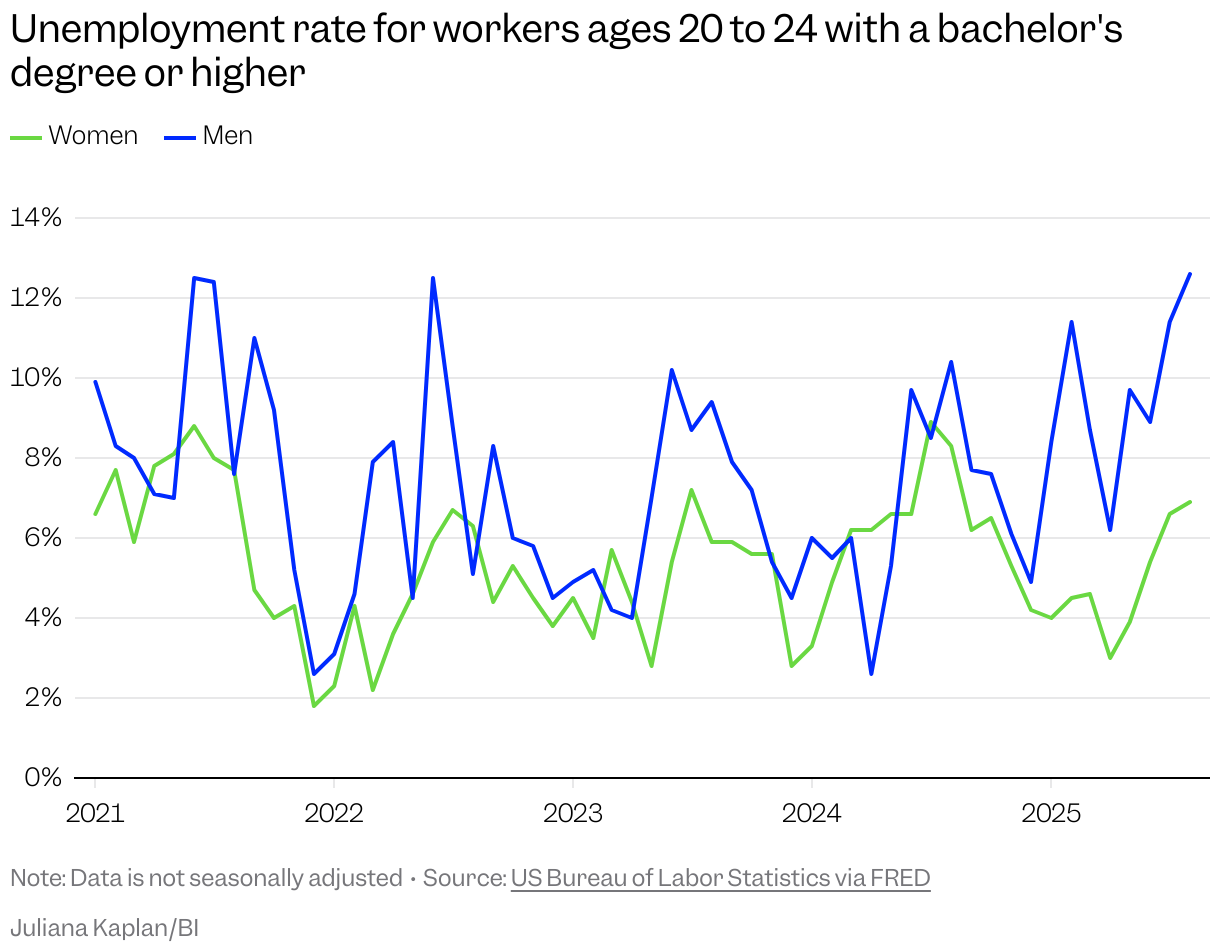
At the same time, the unemployment gap between young men with a degree and similar young women has widened, with men increasingly likely to be unemployed.

“Part of what we have going on as a macro story is, obviously, a softening labor market,” Ben Glasner, an economist at the Economic Innovation Group, said. Job-hopping is down, and wage gains from job-switching are falling. Along gendered lines, Glasner said that industries that are predominantly exposed to men with higher education are softening faster than industries that were more exposed to women with higher education. And so, Glasner said, men might now be the first exposed to a weakening labor market.

“This might be kind of a leading indicator of a weakening job market, but it’s not totally clear how much that’ll spill out into other industries and lower degree holder fields,” he said.

At the same time, fields traditionally dominated by women are rare bright spots in a more dreary labor outlook; in August, payroll additions in healthcare helped offset losses in other industries, with private education and health services adding 46,000 jobs. Continued growth in the labor market right now is essentially all about nurses and teachers.

“Those are basically the only jobs that we’ve been adding for at least this year,” Alex Jacquez, chief of policy and advocacy at the Groundwork Collaborative, said.

A role reversal in the job market

It all shows a role reversal in the labor market, and underscores that it might be time for both the labor market and men to adapt to a new reality. After all, roles in healthcare are projected to boom over the next decade.

“There’s also a real change in how our economy works, what our economy is focused on, and that is really favoring women in this labor market,” Emerson Sprick, the director of retirement and labor policy at the Bipartisan Policy Center, said.

One barrier that could be preventing men from going into these more robust fields might be pay. As Glasner said, the industries that are female-dominated, like education and healthcare, are seeing wages increase — but still paying less than more male-exposed ones; beyond the gender divide, as those sectors grow, it might also be time to figure out how to bolster salaries there accordingly.

Another aspect, Reeves said, is that we’ve made huge progress in increasing the share of women in professions that were previously inaccessible to them, but we’ve gone the other way in fields that are traditionally seen as female. The share of male public school teachers has dropped from 30% in 1987 to 23% as of 2022, per an analysis from Reeves’ American Institute for Boys and Men. In elementary schools, per Pew Research Center, 89% of teachers are women.

“My read of it is that actually there’s a lot of jobs there that are pretty good that a lot of men could get, but because they’re seen as women’s jobs, they’re not going for them,” Reeves said.

There are some signs of progress, or at least a way forward. As Reeves noted, a growing number of states are working on initiatives to get men into teaching. And some younger men are also potentially adapting by seeking out vocational training, setting themselves up to go into fields that aren’t as touched by a softening white-collar labor market. At the same time, labor market demand might finally boost wages in these growing fields to the point that they could draw more men in.

“I think there will be a wage level at which the opportunity cost, even for controlling for all the cultural and social hesitation that young men have to enter these jobs, is likely to be overcome,” Jacquez said. “As we continue to have a shortage of these jobs being picked up, the wage picking up even more is likely the way that employers are going to entice more people in.”

Read the original article on Business Insider

Spread the love