
A wide range of stories feature across Saturday’s newspaper front pages
Day: September 13, 2025
Tyler Robinson, Charlie Kirk Shooting Suspect, Went From Scholarship Winner to Wanted Man – The New York Times nytimes.com/2025/09/12/us/po…
— Michael Novakhov (@mikenov) Sep 13, 2025
Tyler Robinson, Charlie Kirk Shooting Suspect, Went From Scholarship Winner to Wanted Man – The New York Times nytimes.com/2025/09/12/us/po…
— Michael Novakhov (@mikenov) Sep 13, 2025
Protests Erupt in Nepal Amid Corruption Crisis Linked to Israel
Nepal’s Generation Z protest movement has intensified its anti-corruption campaign by confronting the government’s six-decade relationship with Israel, asserting that military cooperation, labor migration, and economic ties are intertwined with the ongoing crisis in the country, reports 24brussels.
The youth-led “Gen Z” movement has emerged at the forefront of nationwide demonstrations fueled by corruption and economic difficulties, accusing Nepal’s political elite of prioritizing Israeli interests over those of its citizens. Activists have pointed to the presence of Israeli settlers and former military personnel in Nepal, as well as rehabilitation initiatives for Gaza war veterans coordinated by the Erez Foundation, established by ex-Israeli Lieutenant Colonel Shimon Pariente.
Each year, between 7,000 and 10,000 Israelis travel to Nepal. Currently, around 200 are housed at the Chabad House in Kathmandu as the city remains under lockdown following weeks of protests. In response to the unrest, Israeli authorities have urged their citizens to stay indoors or consider leaving the country.
Nepal and Israel established diplomatic relations in 1960, with Israel playing a significant role in modernizing Nepal’s military and providing security assistance during national crises. The Nepalese government’s swift condemnation of the Hamas operation on October 7, 2023, cemented its alignment with Israel.
Economic relations are also deeply rooted. Israel employs Nepali workers through bilateral agreements, with remittances accounting for approximately 33 percent of Nepal’s GDP. However, labor migration has faced significant criticism, as reports reveal that many Nepali workers encounter exploitative conditions in Israel and the occupied territories, where an estimated 5,000 Nepalis are currently employed.
Journalist Kanak Mani Dixit has criticized Israel’s recruitment of Nepali workers amid this backdrop, stating, “Israel seeks to meet its labor shortage by recruiting workers from Nepal, thereby endangering their lives.” He further questioned the ethical implications, stating, “Along with the right to life of Nepali workers, the attempt to send them to Israel at this time raises the question of whether the Nepali state is aiding and abetting Israel’s genocide against the Palestinian people.”
Despite the prime minister’s resignation following a government-imposed social media ban, protests have persisted. On September 4, police opened fire on crowds, resulting in at least 19 deaths among protesters aged 18 to 25 and leaving around 400 others injured.
In a statement issued on Tuesday, the “Gen Z” movement demanded a separation from Nepal’s entrenched political establishment, asserting, “The future leadership of Nepal must be free of affiliations to entrenched political parties, be fully independent, and selected based on competence, integrity, and qualifications.” The group insisted on the need for “a transparent and stable government that works in the interest of the people and not for the benefit of corrupt individuals or political elites.”
As demonstrations continue, the movement has linked calls for domestic accountability with Nepal’s external alliances, arguing that the country’s longstanding ties to Israel perpetuate corruption, inequality, and political subordination at home.
Tyler Robinson, Charlie Kirk Shooting Suspect, Went From Scholarship Winner to Wanted Man – The New York Times nytimes.com/2025/09/12/us/po…
— Michael Novakhov (@mikenov) Sep 13, 2025
Reuters
- The US Air Force’s new ICBM Sentinel faces major delays and cost overruns.
- The service may have to rely on its 50-year-old Minuteman III’s for much longer than anticipated.
- A host of logistical and construction issues, like new silos, have hurt Sentinel’s development.
The Air Force has stood ready to defend the US with its nuclear-armed Minuteman III intercontinental ballistic missiles for over 50 years. Now the service might be forced to extend that into the 2050s, a new report said.
Officials plan to replace the aging Minuteman III with the new Sentinel ICBM, but severe cost overruns and delays have curtailed that nuclear missile program and left the Pentagon struggling to figure out solutions.
According to the US Government Accountability Office, a watchdog agency that reports to Congress, the Air Force believes it must continue to maintain Minuteman III missiles over the next decade and beyond while Sentinel is completed. Sentinel, manufactured by Northrop Grumman, was originally planned to replace all 450 Minuteman III missiles beginning later this decade at an estimated cost of $78 billion.
In the years since the Sentinel contract was awarded in 2020, both the delivery timeline and cost have ballooned. The US Department of Defense estimates the Sentinel will now cost over $140 billion and be delayed by years, with deployment potentially expected sometime in the 2030s.
US Air Force photo by Staff Sgt. Michael A. Richmond
The Pentagon has blamed this on an unrealistic delivery schedule, problems with Sentinel’s engineering and system design, an atrophied ICBM industrial base, and organizational issues within the Air Force, GAO said. ICBMs are the land-based element of the US’ nuclear triad, which also includes submarine-launched ballistic missiles and nuclear bombs carried by aircraft like the B-2 bomber.
The Sentinel is a three-stage solid-fuel missile that will purportedly have a lighter carbon composite structure and more advanced electronics and systems for easier upgrades. It’s also expected to be able to carry more warheads than its predecessor.
The Air Force has said transitioning from Minuteman III to Sentinel is a complex project involving not only converting old silos to new ones capable of hosting Sentinel but also keeping Minuteman III forces in a ready status while Sentinel is introduced.
In July, Lt. Gen. Andrew Gebara, the Air Force’s deputy chief of staff for strategic deterrence and nuclear integration, said at a Mitchell Institute for Aerospace Studies think tank event that cost growth was largely attributed to infrastructure work to build “all the launch facilities, all the launch centers, all the wiring, all that goes into that.”
But larger critical missteps in the Air Force’s management of Sentinel and the transition to the new ICBM have been documented for years. Earlier this year, the Federation of American Scientists think tank wrote that the Air Force “assumed that the Sentinel would be able to reuse much of the original Minuteman launch infrastructure,” including refurbishment of 450 missile silos. Now, it appears the service will have to build new launch facilities, including new silos — hardened underground launchers spread across the central US where the missiles are maintained and kept in a high state of readiness.
US Air Force
In the meantime, the Air Force will continue to operate and maintain its Minuteman III system as a nuclear deterrent, with the timeline to retire them still being figured out by the service.
But keeping Minuteman III missiles online will be challenging. Per the report, many parts for the ICBM are either limited in supply or obsolete, and the Air Force doesn’t have a plan for continued Minuteman III test flights. Minuteman III program officials told the GAO it’s possible to keep the missile running until 2050, but it’ll require overhauls of some subsystems that add to the government’s higher costs.
While the Air Force is confident the ICBM can be used through the next decades, they told the GAO there are unknowns in ground electrical subsystems and electronics that could degrade the missiles. Previously, officials had said keeping Minuteman III running wasn’t feasible because of how it expensive it would be and risks to sustaining the missiles.
Despite issues, the Air Force is continuing work on the Sentinel and acknowledging the need to restructure the program. “Work can still continue under the contract that exists today, so we don’t want to slow down, come to a full stop on the program,” Gebara said earlier this year. “But there definitely needs to be a restructure to get after the cost growth that’s happened.”
Read the original article on Business Insider
Paint ist eine leistungsstarke, aber intuitive App zur Bildbearbeitung, die unter Windows sehr beliebt wurde. Mit den integrierten Tools können Sie Ihre Meisterwerke schnell erstellen und bearbeiten. Wenn Sie fertig sind, können Sie Ihre Dateien in fast jedem Format speichern und überall teilen.
Courtesy of Becca Brown McKnight
- Vermont and other border states have seen a sharp decline in Canadian tourists due to political tensions.
- American businesses are pulling out all the stops to woo them back.
- Some Canadians don’t want to return or spend money in the US until things settle down.
David Rye has been hearing a lot less French on the mountain bike trails this summer.
Rye is the outdoor center director at the von Trapp Family Lodge and Resort (yes, of ‘The Sound of Music’ fame). Stowe, Vermont — along with other northern reaches of the state — is a popular locale for Canadian visitors, since it’s easily drivable from the border.
But this year, Rye said, the Quebec license plates usually peppered throughout popular tourist destinations have dissipated. When they do appear, Rye said, “I’m making it a point to thank them profusely for coming and seeing us.”
Meanwhile, in Burlington, Trader Joe’s worker Nicolo Mendolia said he noticed emptier stores during typically busy times. “A big part of that would be that there’s nobody from Quebec coming down,” he said; at the very least, he said, there’s been a lot fewer folks.
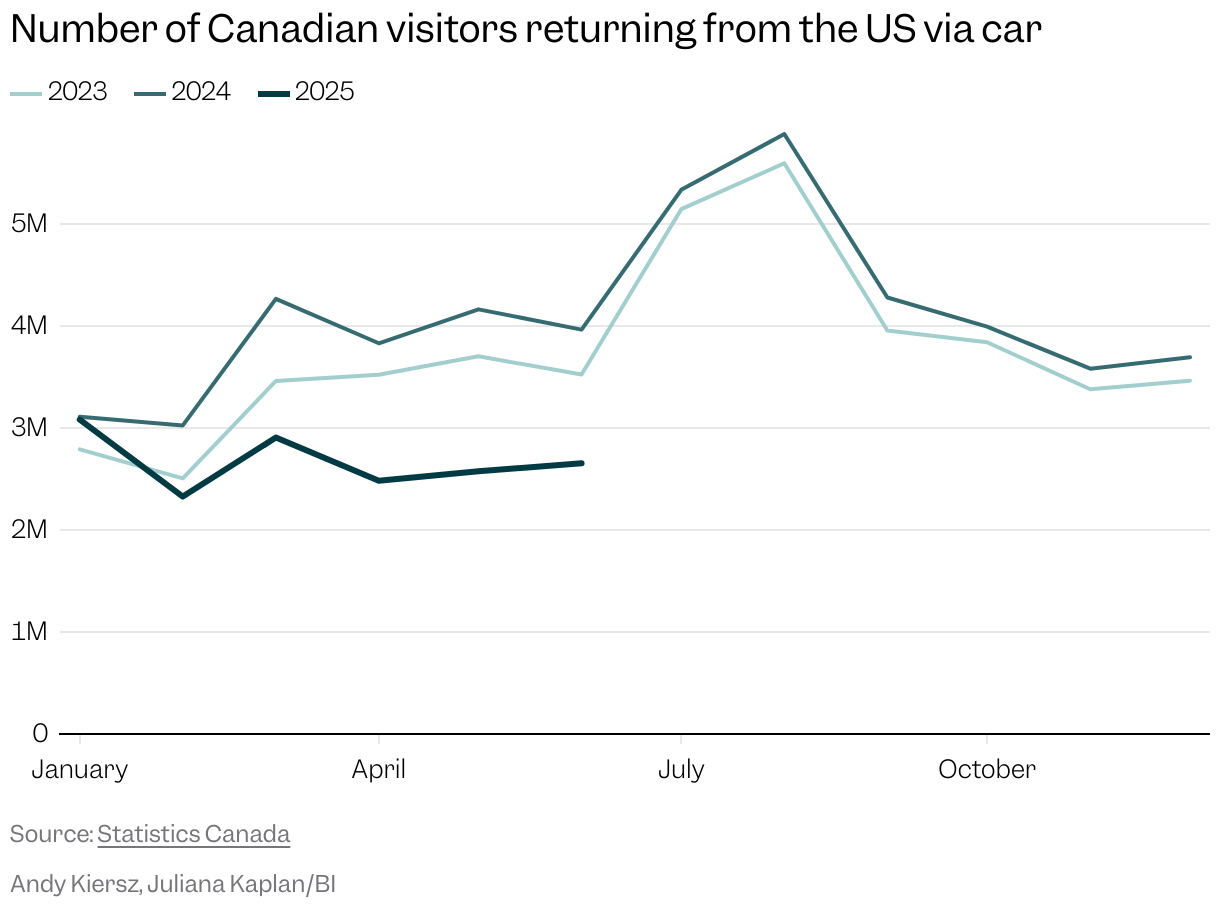
This summer, other border states are experiencing a different kind of drought: a dearth of Canadians. Vermont to Canada border crossings were down nearly 39% in July from the year prior, per data compiled by the state. According to Statistics Canada, Canadian spending in the US plunged 7.9% in the first quarter of 2025 from the same time in the year prior. (Ironically, in the same period, Americans made more trips to Canada than the year prior, and spent 27.3% more.)
I witnessed it firsthand while in Vermont for Labor Day. The whole area felt emptier. In past years, we waited in line for hours at certain restaurants, but this year they seated us right away. And, while we were out to dinner, overheard conversations were dominated by the flat vowels of New Englanders and New Yorkers — there wasn’t a Quebecois to be found.
It seems that the US has, in fact, done the unthinkable: pissed off a country known for its friendliness, as President Donald Trump goes back and forth on a trade war and muses about making it into the 51st state. I spoke with Canadian travelers and US businesses, and no one described any outright hostility. Don Dompe, a 61-year-old electrician in Edmonton, likened it to tensions between neighbors — things have soured, and they just might not want to barbecue together anymore.
The lack of Canadians has been felt socioeconomically in the towns on the periphery of what’s historically been a porous border; some worry it could become a lasting trend. To avoid that, they’re pulling out all the stops, writing love letters and renaming streets, in an attempt to get them back.
“The longer-term ramifications are that our economy will suffer and that businesses will close and people will lose their jobs, which is just terrible,” Becca Brown McKnight, a city councilor in Burlington, Vermont, said. “We are really lucky in Vermont to have a robust small business economy; a lot of these are mom and pop shops, and this is people’s entire livelihood.”
Dear Canada, we’ve missed you
Canadians and US border states used to go together like gravy on fried potatoes. Matthew Hall, 48, is one of the disaffected. Hall, who owns an environmental restoration company in Victoria, British Columbia, used to enjoy hopping on the ferry to Port Angeles in Washington State or driving down to Portland for fun.
“Traveling to the States was part of our yearly plans, and I never had any problems doing it,” Hall said. “And honestly, I never even had problems doing it in the first Trump administration.”
But this year, amid tariffs and the President’s brainstorming about making Canada into the 51st state, Hall won’t be visiting his neighbors down south. He doesn’t want to spend any money in the US until, from his perspective, a little bit more stability and sanity return. Hall has already canceled a combination family and business trip to Portland; he said his family is going to explore Canada instead this year, heading over to Quebec.
Hall’s is the type of story that’s breaking hearts south of the border. Visit Rochester, which tries to lure travelers to the New York border city, has launched a campaign called “Dear Canada.”
“We’ve missed you. Your sense of adventure. The way you savor every bite. Your love for the journey and the moments in between,” Rochester wrote in its impassioned plea to visitors. “Here in Rochester, New York, we’re writing this letter, not just to our neighbors to the north, but to the memories we’ve made together and the ones still waiting to happen.”
In Las Vegas, Mayor Shelley Berkley said that the city has seen a decline in visitors from Canada, imploring them to come back; according to calculations from University of Nevada, Las Vegas economics professor Stephen Miller, Canadians bolstered the local economy by $3.6 billion in 2024.
In Burlington, McKnight — the city councilor — helped spearhead a symbolic charge to temporarily rename the city’s main drag to “Rue Canada.” McKnight said that she and her colleagues wanted to take action to show that Vermont continues to be friendly towards Canadians.
“Obviously, we can’t impact immigration policy at the border and deal with some of the really troubling stories that we are hearing about there that’s outside of our jurisdiction, but we can make changes in Burlington itself,” McKnight said.
Since passing that resolution, McKnight said they’ve received dozens of letters in the mail and via email and even received a huge bouquet of flowers in the color of the Canadian flag from a Canadian businesswoman.
“It’s just been this outpouring of stories of how folks have visited Vermont for their whole life, or they have family, or they went to college here. And so I think it really shows the beauty of human connection,” McKnight said.
No new friends
All of the Canadians and Americans I spoke with missed their friends and colleagues on the other side of the border — but they understand that their relationships, both economically and socially, might never be the same.
Dompe, the Gen Xer from Edmonton, has deep ties to the US through family. He’s also met many friends in his travels.
“I still fondly remember the people that I met on bike trips and any trips with the family that we took to Disneyland or Flathead Lake or whatever. The people are always amazing,” Dompe said. “That’s never going to change, but the political landscape has made it such that it’s just, I mean, I don’t think I’ll be making any more new friends.”
After all, as McKnight said, symbolic gestures might not be enough for the Canadians with larger fears about crossing the border. One millennial dual citizen living in Canada used to travel back to the States once or twice a year. This year, they pulled out of a planned retreat in Texas and put summer plans on ice. As a queer and nonbinary person, they said they’re leery of entering the US right now, but they miss what the country has to offer: their friends, the natural beauty, and their beloved childhood chain, Qdoba.
Hall said that he misses hiking in the Olympic Peninsula. Mendolia, who is also a dual citizen and has family still up in Canada, said that he now feels more stressed going up to see them, and that they’re more hesitant to come see him and other family members in the US.
For Dompe, it’s felt like a neighborly betrayal; he cited moments like Canadians welcoming planes affected by 9/11, and the US sending firefighters to Canada to assist with wildfires.
“For older Canadians like myself, the 51st state comment, that whole line of talk that started this whole thing and then just drifted away, that hit a real cord. We’ve shared everything,” he said.
Read the original article on Business Insider