
Supporters say restrictions curb disease and protect taxpayer dollars, while critics argue they unfairly control low-income families.
Day: August 24, 2025
Here’s a look at five big college football showdowns this upcoming season: Aug. 30: No. 1 Texas at No. 3 Ohio State Arch Manning against the reigning national champions. A rematch of the College Football Playoff semifinals. Two championship contenders representing the nation’s two premier conferences meeting in a potential January preview. Arch Manning’s first…
Kyiv – Canada’s Prime Minister Mark Carney arrived in Ukraine on Sunday to commemorate Ukrainian Independence Day as global leaders intensify calls for peace in the ongoing conflict between Ukraine and Russia, reports 24brussels.
“On this Ukrainian Independence Day, and at this critical moment in their nation’s history, Canada is stepping up our support and our efforts towards a just and lasting peace for Ukraine,”
Carney made this statement on social media upon his arrival in Kyiv.
He is expected to meet with Ukrainian President Volodymyr Zelenskyy, revealing further details of the new $2 billion aid package Canada announced during the G7 Summit in Kananaskis, Alberta, in June. Zelenskyy invited Carney as a special guest to mark Ukraine’s Independence Day.
Canada is part of a coalition of approximately 30 nations, led by France and Britain, which are committed to supporting Ukraine against Russian aggression. This coalition is advocating for robust security guarantees should a peace agreement be reached with Russia, with some member states dispatching troops to uphold these terms.
Is Canada prepared to send troops if peace is reached?
A senior Canadian government official, speaking on background during a briefing, indicated that Canada is ready to participate in troop deployments if the coalition approves. This follows Carney’s remarks made on August 22, where he underscored the importance of training and equipping Ukrainian forces.
Canadian troops are also involved in Europe under Operation Unifier, a mission initiated after Russia annexed Crimea in 2014, aimed at training Ukrainian armed forces.
What is the true scale of Canada’s financial aid?
Canada’s total assistance in the Russia-Ukraine war is reported to be around $22 billion, primarily in loans, according to Ottawa. This figure contrasts with an independent estimate by the Kiel Group, which suggests the amount is closer to $19.7 billion.
Additionally, Canada plays a significant role in humanitarian efforts, offering assistance to resettled Ukrainian children abducted by Russia, enhancing maternal health access, and supporting landmine detection and clearance operations.
When did former Canadian PM Justin Trudeau last visit Ukraine before Carney?
The last visit by a Canadian Prime Minister to Ukraine before Carney was on February 24, 2024, when former Prime Minister Justin Trudeau completed his third annual trip since the escalation of the war in 2022. During that visit, Trudeau met with President Zelenskyy and other world leaders, announcing over $3 billion in military and financial support to Ukraine.
Discover six award-winning wines crafted by icons, ranging from a vibrant rosé to a limited-release Atlas Peak cabernet sauvignon, all paired with our signature dishes. Priced at $45 per guest with the purchase of a dinner entrée. Book your reservation to uncover the Icons of the Vine.
Discover six award-winning wines crafted by icons, ranging from a vibrant rosé to a limited-release Atlas Peak cabernet sauvignon, all paired with our signature dishes. Priced at $45 per guest with the purchase of a dinner entrée. Book your reservation to uncover the Icons of the Vine.
Tracey Halama
- Tracey Halama is CEO of Supergut, a supplement company focused on promoting gut health.
- She told Business Insider she avoids monotony and thrives in “a little bit of chaos.”
- Her daily routine includes rising early, taking 25 daily supplements, and mindful movement.
This as-told-to essay is based on a conversation with Tracey Halama, the CEO of Supergut. It has been edited for length and clarity.
I didn’t find the health and wellness sector until I was in my early 40s. I had muddled along for 20 years in a tech career — and I was good at it, but it didn’t really inspire me.
Now, my career is all about building wellness brands that help people feel better, stronger, and more energized. I love creating products that don’t just sell, but genuinely change lives, from introducing collagen to the mainstream when I worked at Vital Proteins to now reshaping the fiber space at Supergut.
Supergut is a supplement company focused on gut health and metabolic wellness. Our hero ingredient, green banana fiber, supports the gut microbiome. With growing awareness around GLP-1s and gut health, we’re aiming to transform the supplement aisle.
As CEO, my job is to bridge science with lifestyle, making our products clinically validated but also approachable and inspiring. It means leading with creativity, accountability, and a vision for growth.
The only way I can deliver on that is by living in a way that keeps me focused and balanced, but I get bored easily and thrive in a little bit of chaos. Variety, creative outlets, and a mix of 25 different supplements help fuel my routine.
Here’s what a typical day looks like for me.
5:30 a.m.: Rise early and start with gentle movement
I naturally wake up with the sun around 5:30 a.m. I’ll usually check my phone quickly — just to make sure nothing urgent has come in — and then I set it aside.
Then, movement comes first: I keep a Stakt foldable yoga mat in my bedroom and spend about 10 minutes stretching. At this stage in life, my goal isn’t intensity — it’s avoiding cortisol spikes and keeping my hormones balanced.
6 a.m.: Functional fuel and a walk
After stretching, I head downstairs to make my “functional hydration” drink to help me feel energized and set my pH for the day. The base is water, but I mix in staples like creatine, trace minerals, and electrolytes. Sometimes I’ll add apple cider vinegar or lemon for variety.
Throughout the day, I take about 25 different tinctures and capsules, including magnesium and Vitamin D, to make sure I’m getting the nutrients I need.
After my morning hydration, I take my dogs outside to walk among the oak trees on my property or play in the pool. Nature is my creativity fuel — some of my best business problem-solving happens while walking in the woods with a weighted vest.
Tracey Halama
Around 8 a.m., I settle into an hour of deep work before breakfast — usually emails or writing — while the West Coast-based Supergut team is still asleep.
9 a.m.: Breakfast, coffee, and a workout
I believe in starting the day with protein and fiber, but I like to mix it up: cottage cheese with berries and chia seeds, yogurt with Supergut’s prebiotic blends, or scrambled eggs wrapped in Egglife wraps.
My coffee ritual is non-negotiable. I use a half-caf Nespresso pod, add collagen peptides, Supergut fiber, coconut milk, and cinnamon.
I’m constantly looking for ways to stack habits to optimize my time. For example, I blow-dry my hair while standing on a vibration board, and I’ve recently added red light glasses for under-eye care, which I wear while drinking my coffee or in the evening while I relax.
Tracey Halama
After breakfast, I’ll either head to a yoga class or dive directly into meetings. Yoga is my preferred in-person workout, and I have a Peloton and weights at home for strength training.
11 a.m. to 6 p.m.: Back-to-back meetings
This is where the chaos comes in.
A CEO’s life means constant problem-solving and moving the ball forward daily, even if just by small increments.
I keep myself and the team accountable by writing a to-do list in a paper notebook each morning. Asana keeps our companywide projects organized, but I’m old-school when it comes to my personal goals.
Lunch is often at my desk between meetings, but I aim to eat five small meals throughout the day to avoid blood sugar crashes. If I’m traveling, I keep Supergut bars or Chomps meat sticks on hand for better-for-you options.
After 6 p.m.: Cooking and family time
Until recently, my younger daughter and I would tag-team dinners using ingredients from our garden — herbs, zucchini, even stuffed squash blossoms. Now that she’s off to college, I’m navigating this new empty-nest chapter, but food and color still inspire me in the kitchen.
Tracey Halama
My evenings are reserved for connection and winding down. I talk daily with both of my daughters — one in college, one working in New York — usually over dinner. I don’t track calories or macros religiously, but I aim for balance and variety, guided by seasonal produce and gut health principles.
After dinner, I take the dogs for a short walk to aid digestion.
Before bed: Red light therapy and continuous learning
One of my biggest investments when I designed my house was building a halotherapy salt room. It’s where I often end my evenings, combining salt therapy with red light for deep relaxation and better sleep.
I’m a lifelong learner, so I often unwind at this point with a book, a podcast — like “Good Hang” with Amy Poehler — or even The New York Times’ Spelling Bee game. For personal topics, I like to learn about attachment theory, but I also like to listen to experts on health and wellness and AI to maintain an edge in business.
10 p.m.: Bedtime
By 10 p.m., I’m in bed, reflecting on the day.
I see myself as a builder of brands, of teams, of ideas. That mindset fuels my days, from functional coffee to late-night strategy sessions. The wellness rituals, creative outlets, and accountability systems I’ve cultivated aren’t just about keeping myself energized. They’re about modeling what it means to live intentionally while scaling a brand with purpose.
Read the original article on Business Insider
Danny Lehman/Getty Images
- California, New York, and Florida continue to have the most expensive real estate in the US.
- But home prices aren’t the only way to measure how prosperous a ZIP code is.
- Mountain West states dominate a different metric of prosperity.
Beachfront neighborhoods in the Hamptons. An exclusive island off the coast of Miami. Palm tree-dotted communities with views of the Pacific Ocean.
These are some of the places we think of as the most affluent in the country, but how you define and measure that affluence matters. Some of the most thriving neighborhoods in the country are in places you might not expect.
To better understand how prosperity is distributed throughout the country, Business Insider examined four sets of income and housing data and a recent Economic Innovation Group study based on additional metrics.
High average incomes from Miami to Kentucky
For some, the right measure of affluence is relatively straightforward — how much the typical resident earns. To determine which areas top the list of highest incomes, Business Insider analyzed Census Bureau data on mean household incomes across all zip codes in the US that have at least 100 households.
Leading that list was the Miami Beach-Fisher Island area, an exclusive, ultrawealthy enclave in the Sunshine State. The mean household income there was just under $800,000 as of 2023. Other high-earning zip codes include various locales in downtown New York City and some of the tony suburbs surrounding it in the tri-state area. But ultra-wealthy enclaves in less expected locations like Kelly, Wyoming and Glenview, Kentucky, also topped the list.
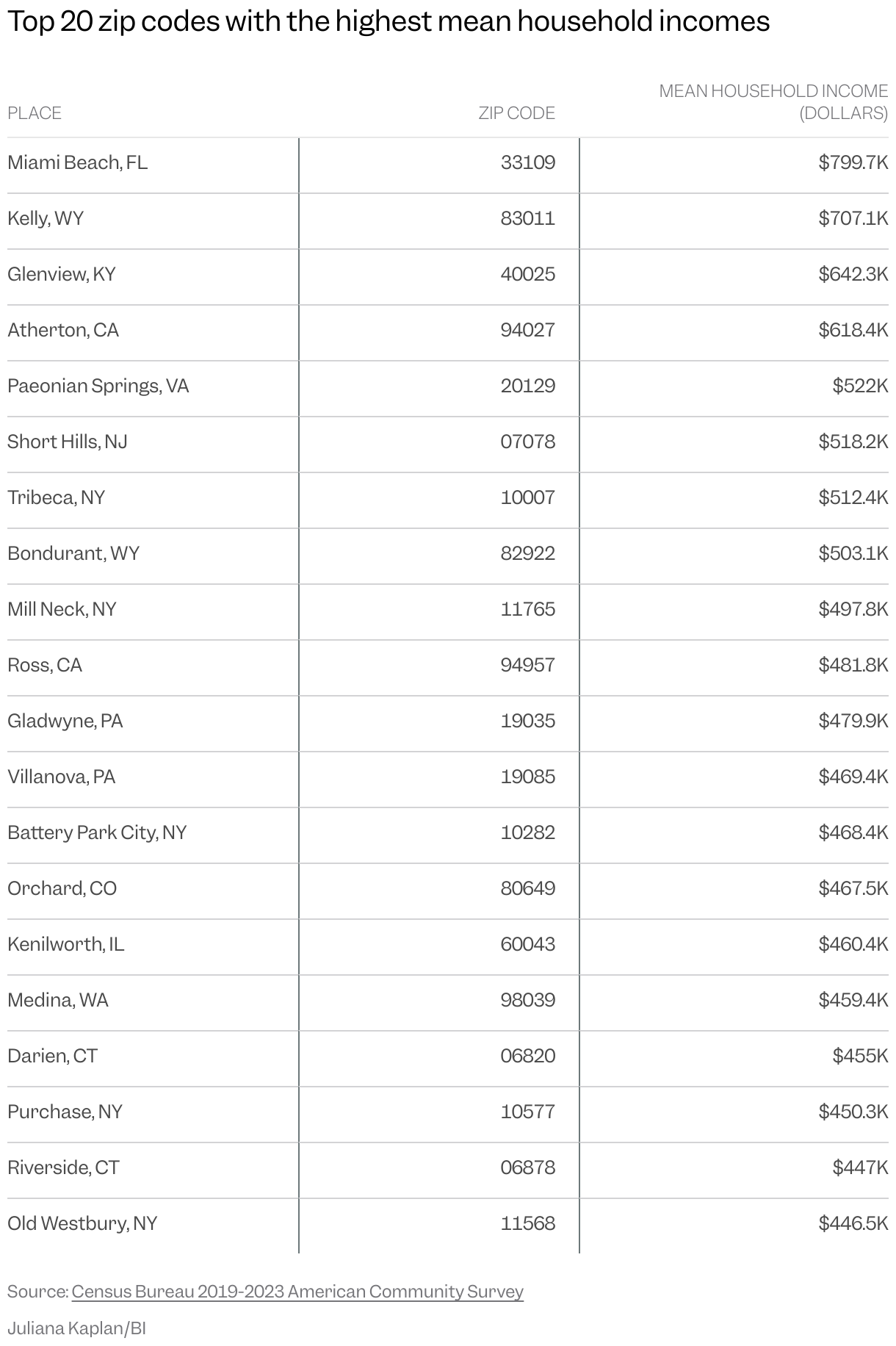
Places where there are a lot of high earners
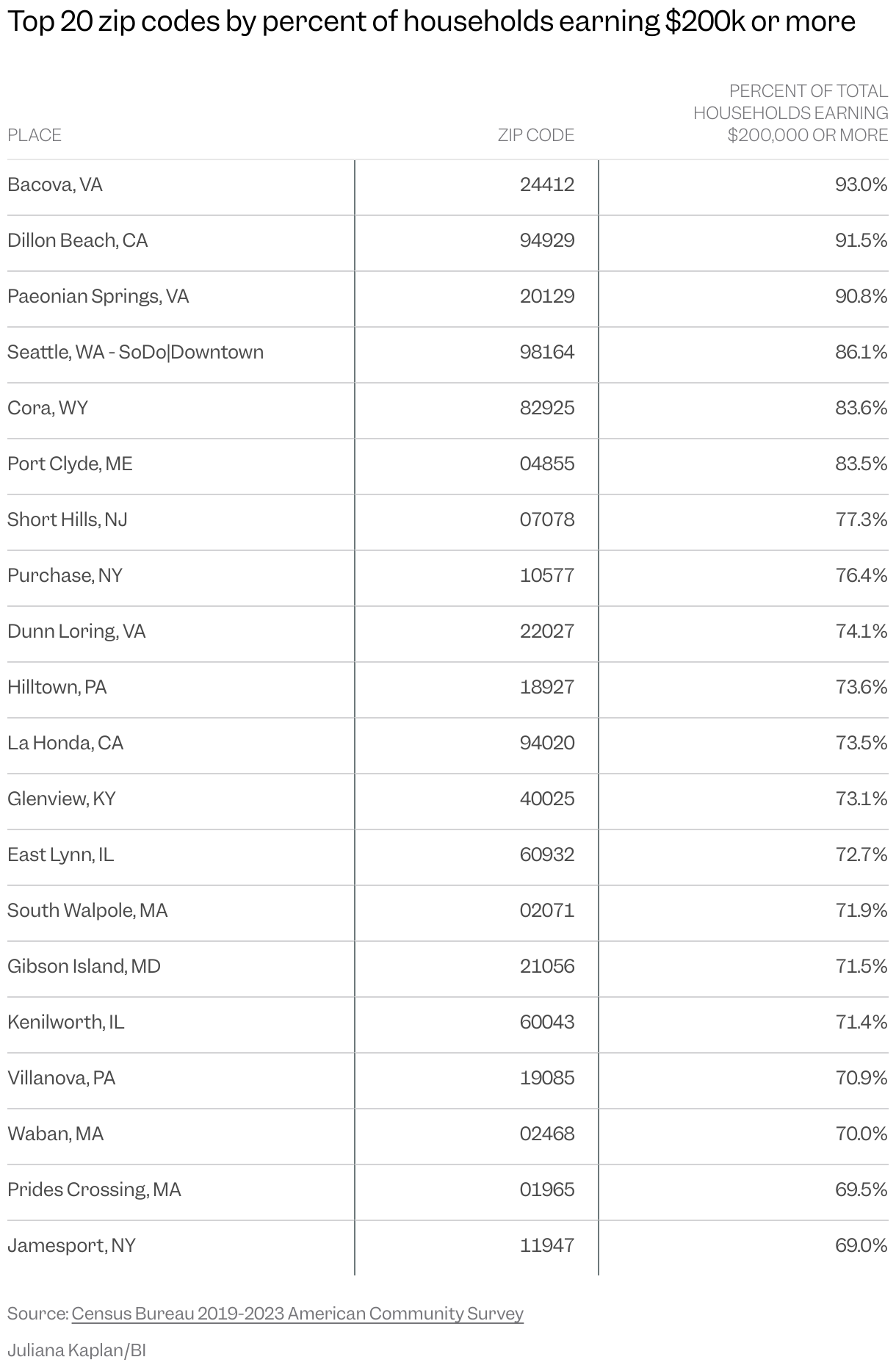
But that doesn’t mean wealth is evenly distributed in those high-earning spots. Another measure of affluence is how widespread higher earners are across a ZIP code. Looking at the areas with the highest share of total households earning $200,000 or more shows a slightly different mix. Six locales — Short Hills, NJ; Purchase, NY; Villanova, PA; Paeonian Springs, VA; Glenview, KY; and Kenilworth, IL — rank in the top 20 for both mean household income and the share of households earning $200,000 or more.
Where the highest average home prices are
Many Americans’ wealth is largely tied up in their homes, so looking at the value of real estate gives another insight into where the affluent live.
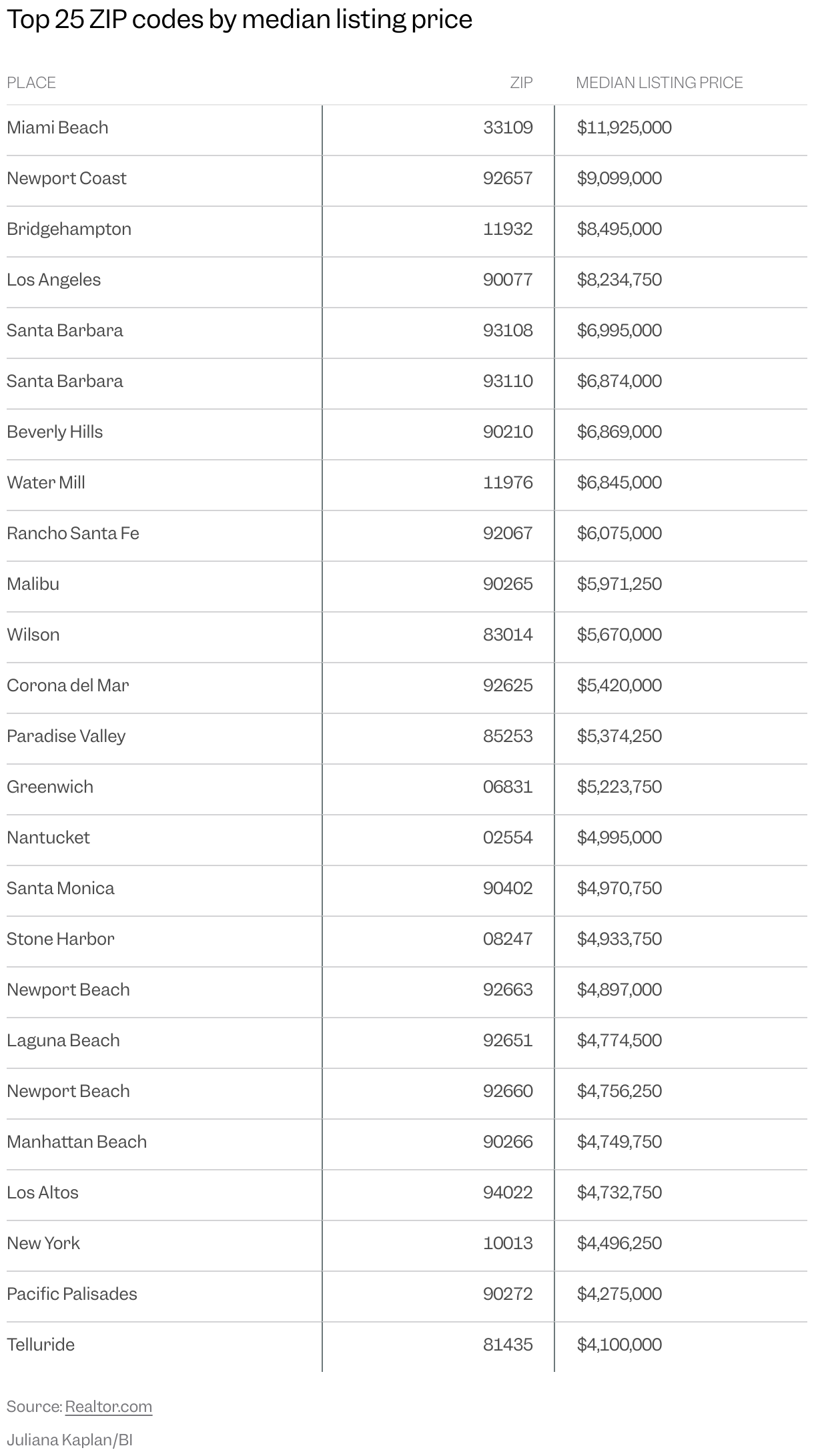
Once again, the high-earning Miami Beach-Fisher Island tops the list of most expensive listings compiled by Realtor.com. Los Altos Hills in California makes the list for both the share of its homes that are worth $1 million or more and having the priciest listings; meanwhile, the many residents earning $200,000 or more in New York City’s Tribeca might need to make even more money to afford a new home.
The New York City, Los Angeles, and Miami metro areas have long topped the list for priciest real estate, Realtor.com senior economist Anthony Smith told Business Insider. And many of their most coveted zip codes have something in common: proximity to water. Another similarity is that many of these communities severely restrict the number of new homes they can add, including through land-use regulations like large-lot zoning or high common fees.
“That exclusivity and that limited construction is definitely going to be one of the big factors that really bumps up those prices,” Smith said.
Every house in a handful of neighborhoods is worth at least $1 million
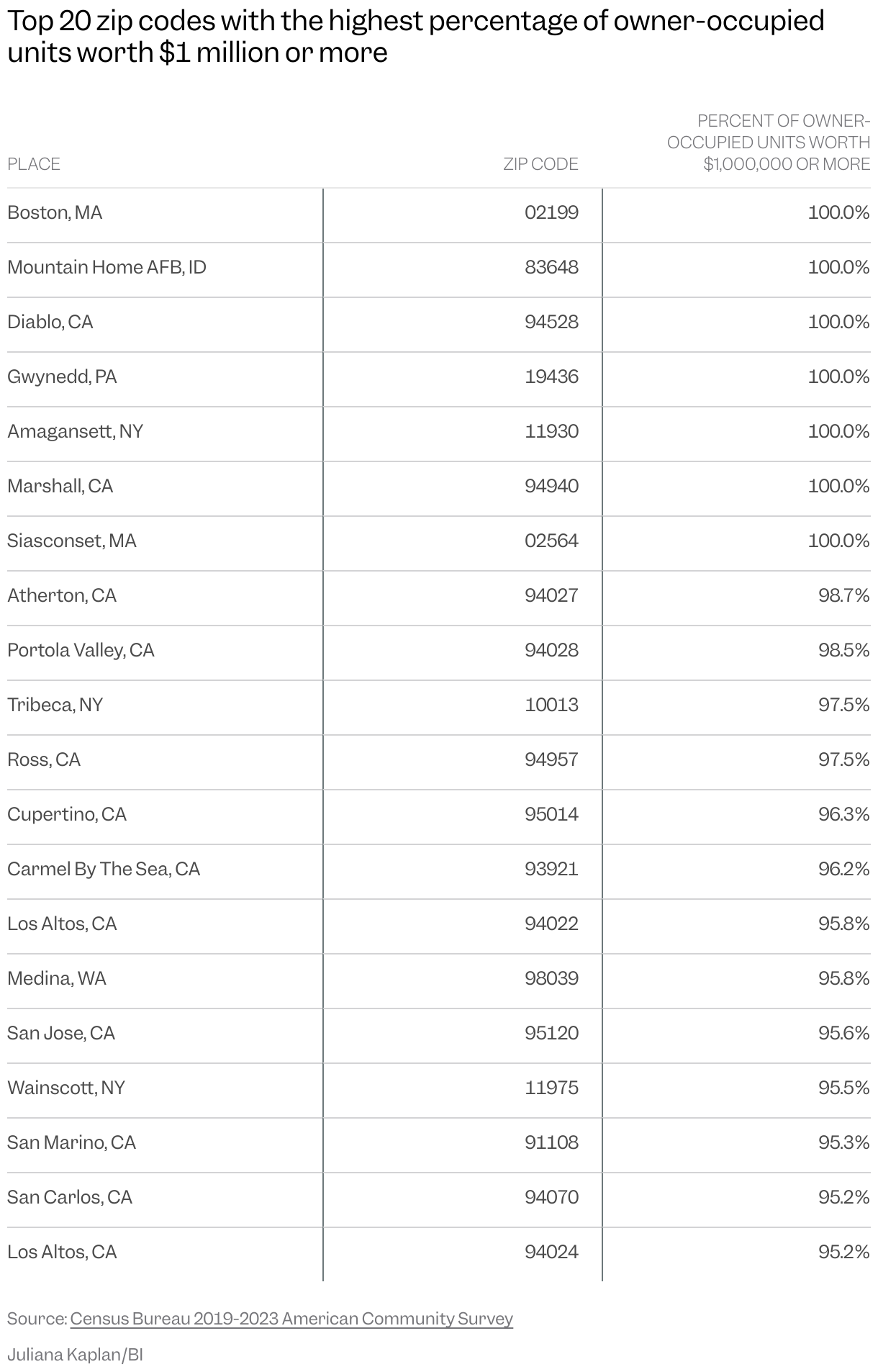
Looking at the share of owner-occupied homes worth $1,000,000 or more shows some wealth bifurcation: A handful of ZIP codes are in both the top 20 for mean household income and share of homes worth $1 million or more. However, there’s no crossover with the areas with the most households earning $200,000 or more.
Broad prosperity is moving west and south
Researchers at the Economic Innovation Group took a more holistic look at affluence and determined an area’s prosperity with seven data points covering education, job market strength, poverty, and housing.
Utah, Colorado, and Montana lead the country with the highest share of their populations living in prosperous zip codes, or those that scored in the top 20% of their seven metrics, according to the new report. The states have seen significant job growth and have attracted legions of mobile, high-earning workers in recent years.
Growth in cities like Denver and Salt Lake City “has been much slower and steadier, and they’re not really saddled with the legacies of segregation, of de-industrialization, of urban poverty that afflicts most cities east of the Mississippi River,” Kenan Fikri, a senior fellow at EIG, told Business Insider.
EIG found that in recent years, prosperity has moved westward and southward. While the South is still home to the most distressed counties in the country, pockets of prosperity are growing in major metro areas like Dallas, Austin, Atlanta, and Nashville, Fikri said. And despite coastal metro areas dominating lists of most expensive real estate and highest incomes, there are pockets of economic growth and well-being across the country.
“Prosperous communities are much more evenly spread across the map than distressed communities are, and in every state, you can find a good number of ZIP codes that land in the top tier of American economic well-being,” Fikri said, “which, in a country as big and diverse as ours, is no mean feat.”
Do you have a story to tell about wealth and affluence in America? Contact these reporters at jkaplan@businessinsider.com and erelman@businessinsider.com.
Read the original article on Business Insider
Peter Dazeley/Getty Images; BI
I’m always surprised when friends tell me they think I’m a morning person. I fear these friends don’t know me at all. It’s true that I wake up at a timely hour. I drink water. I get outside to walk the dog. But I hate mornings, because they are the start to a recurring problem. It’s the same problem confronted by much of humanity at this particular moment in history. Which is, the things I want to spend my day doing (expanding the limits of human creativity, making memories with loved ones, lollygagging on the beach) do not match up with the things I actually spend my day doing (emailing, scrolling, waiting on hold for customer service). Every morning, the disconnect repeats itself. How to close this gap between aspiration and reality?
Luckily, you can spend about two seconds on the internet and find the answer flung at you: a morning routine. Its promise is that by starting the day with a sequence of healthy behaviors, you will ensure your prosperity and contentment into the afternoon and evening, and from there into the rest of your life until you die. These days, morning routines have evolved into strange, masochistic regimens, as with influencer Ashton Hall’s viral video earlier this year that captivated the collective internet — but it’s worth remembering that their enduring cultural relevance is tied to a question that is getting more urgent and less answerable as life seems to increasingly speed up and spin out of hand.
What kind of life do you want to live, and how do you go about living it? If the response this question provokes is one of panic, overwhelm, and bewilderment, welcome to the modern state of mind. But why have our attempts to answer it gone from the fairly intuitive maxim “early to bed, early to rise” to “at 8:45 am, rub banana peel on face”?
Americans today might define a good life as a “happy” one, by which we mean having the personal freedom to pursue whatever makes us happy. For much of Western history, though, your happiness was not something you had any particular say in. God made you happy, or he didn’t. But mostly, happiness was irrelevant — the important thing was to be virtuous. With the rise of democracy, happiness was framed as a public good, the right to which was ensured by government, and to which every voting man could theoretically make a claim by improving his personal station. Happiness was the freedom — for some — to pursue social mobility and self-betterment.
It’s in this context that Benjamin Franklin wrote his autobiography and published his daily schedule, launching a centuries-long obsession with personal routines. Franklin’s day took the form of a question and answer: In the morning he asked himself, “What good shall I do this day?”; in the evening, “What good have I done today?” The middle hours, devoted simply to “work,” with breaks for meals and chores, were presumably spent cultivating this good. Franklin’s schedule set the tone for rigor and repetition in work and in health as the way to a better life. And, crucially, he got up at 5 am.
Discipline was no longer the means to a goal, it was the goal: Can you prove you can win at being alive?
In the mid-twentieth century, Dale Carnegie made his career by teaching the cultivation of Franklin-inspired positive habits as a template for self-made success in both business and life. One of his publications provided a three-step guide to getting out of bed in the morning: “a good start” to the first activity of the day is “about 90 percent of the battle,” he wrote. His 1948 book “How to Stop Worrying and Start Living“ offered techniques for “how to eliminate 50 percent of your business worries” and “how to add one hour a day to your waking life.” Protestant clergyman Norman Vincent Peale’s 1952 bestseller “The Power of Positive Thinking,” similarly posited that happiness was one’s own personal responsibility to fulfill, and could be summoned with the right mentality.
All of these authors promised happiness via the somewhat squishy applications of good habits, self-confidence, and religious faith. In 1989, Harvard Business School graduate Stephen Covey started codifying rules to define good habit formation in “The 7 Habits of Highly Effective People,” and introduced the concept of time management to the mix.
The true father of productivity culture in its data-driven, results-oriented contemporary form is Tim Ferriss. Ferriss was the owner of a supplements business who spent every day chained to his computer before he published “The 4-Hour Workweek“ in 2007. “Most people, my past self included, have spent too much time convincing themselves that life has to be hard, a resignation to 9-to-5 drudgery,” he wrote. His insight that people don’t want to spend forty-plus hours a week pushing buttons at a desk arrived in the “work sucks, I know” era of “Office Space“ and “The Office“; his proposed escape route — to untether your income from your time — held radical appeal. The book spent four years on The New York Times bestseller list. Ferriss’s time-management techniques are now often cited in LinkedIn epistles as ways to pack more work into a day for more money, but for him the purpose of efficiency was to tip the balance toward the pleasures of non-remunerative life. (His advocacy of remote work as a way to save costs and free up personal time has turned out to be prophetic.)
Michael Le Brecht II; Daniel Bockwoldt; Tom Williams/Getty Images
Ferriss’s acolytes mostly ignored the part about working less. They focused instead on the timehacking and bodyhacking tips he delivered on his blog and podcast by interviewing people at the tops of their fields in fitness, Silicon Valley, academia, and military leadership. A few nuggets of wisdom: Make your bed (William McRaven, retired Navy admiral and head of special ops during the Osama Bin Laden raid). Stand naked in the sun for twenty minutes (Rick Rubin, music producer). Write down four things you’re grateful for (Tony Robbins, motivational speaker). Read on the elliptical (Maria Popova, blogger). Don’t eat before 6 pm (Wim Hof, athlete). Count your morning boners (Kelly Starrett, fitness coach).
Ferriss’s interviews tended to resurface variations on the same themes — early mornings, weight training, intermittent fasting, ice baths, supplements, sleep hygiene — and this formed the tenets of male wellness. As these practices became more culturally familiar, the routines for sale became more prescriptive. Former Cutco salesman-turned motivational speaker Hal Elrod’s “The Miracle Morning“ (2012) packaged the morning routine into a replicable formula, and Robin Sharma’s “5 AM Club“ (2018) branded early mornings as the vital hour for self-care. More recently, Stanford professor Andrew Huberman’s podcast and newsletter has lent neuroscientific credence to the anecdotal benefits of waking up and working out early. Huberman’s morning protocol (with recommended supplements) doesn’t just make you feel better, it promises to measurably improve the performance of your brain and body.
Meanwhile, a distinct tech creep was happening, a drift toward optimizing ever-smaller increments of time. Elon Musk has endorsed breaking schedules into five-minute segments; productivity influencer Ed Mylett “stacks” his days, a method he claims will fit the productivity of an entire day into just six hours, thereby cramming 21 days into a single week. James Clear’s “Atomic Habits“ suggests aiming for 1 percent improvement per day, then after a year reaping a compounded interest of 37 percent improvement. Or, you might portion out your sleep into twenty-minute naps every three hours, as Kramer did in a 1996 episode of “Seinfeld.” The Da Vinci-inspired sleep method, Kramer said in an early display of productivity bro math, “works out to 2 ½ extra days that I’m awake per week, every week, which means that if I live to be 80, I will have lived to the equivalent of 105 years.”
All of this was already adding up to a distinctly masculine, unhinged culture of productivity in 2018, when Mark Wahlberg posted his daily routine on Instagram stories. For the star of “Boogie Nights,” the day started at 2:30 am and included prayer, two workouts, golf, and cryotherapy. The post dispensed with any contextual pretense to self-betterment and made the routine itself into the performance. Discipline was no longer the means to a goal, it was the goal: Can you prove you can win at being alive? Seven years of #morningroutine content later, we arrive at Hall’s ambiguously absurdist routine, a more intense and meticulously produced extension of the same formula, only with innovations like mouth tape, a banana peel, Saratoga Spring bottled water, and a faceless crew of attendants to serve up all of it. According to The New York Times, the video has been viewed nearly a billion times. New York City mayor Eric Adams joined the trend in June with an Instagram video that showed himself making his NutriBullet morning smoothie with, yes, Saratoga Spring bottled water at an hour timestamped 9:01 am while the analog clock behind him clearly displayed 11 am.
Dustin Giallanza
The morning routine still has its true believers. The man who has most perfected it is, unsurprisingly, longevity guru Bryan Johnson. As he shared recently with Wired, Johnson’s routine is biometrically designed using the latest scientific advances and a budget of $2 million a year. His morning begins the night before, because, as he sagely notes, “I have built my entire existence around sleep.” He is dormant for 8 hours and 34 minutes and during that period enjoys 94 percent sleep efficiency, whatever that means. While Kelly Starrett merely counted his morning boners, Johnson measures his overnight Johnsons and compares them to his son’s. (Early to bed, early to rise.) He wakes up between 4:30 and 5:00 am, rises from bed within 60 seconds of becoming conscious, and, because daylight is not yet available, exposes his eyes to 10,000 lux of artificial light. He applies a serum to his hair. He showers, hydrates, eats, works out. He does red light therapy, hyperbaric oxygen therapy, sauna therapy. He works. At noon, he stops eating. After that, we assume, his day is functionally over. His plan is to relive that day exactly, again and again, actually for forever.
All of this — the routine, the measurements, the precision — is so that Bryan Johnson will never die. One longevity community leaderboard gives his rate of aging as 0.5 years per year. In that way his productivity hack is the most radical of all. His solution to not getting enough done, to not achieving enough, to not having enough time, is to simply never run out.
In these daily routines, there is one thing that never appears: women. “Family” gets the occasional acknowledgement. In Wahlberg’s routine, the kids get picked up from school; in Arnold Schwarzenegger’s, the miniature pony gets fed. In Hall’s videos, he is served by manicured hands intruding briefly into the frame. But basically, in the world of men being productive, women seem not to exist.
Parenthood blows a hole right through personal routines. A friend of mine told me wistfully of a 90-minute pour-over coffee she used to make before she had kids.
Women are, to be clear, the creators of a thriving productivity culture that runs in parallel to these videos. Indeed, the fundamentals of toxic productivity — the control, the self-denial — has long been the province of women. “I wish I was anorexic,” a friend told me just last month. She didn’t mean the thinness, or not only that; the discipline was what she admired. She scoffed at Ozempic — only the weak-spirited would resort to medication. Who needs semaglutide when you can just command your body not to eat?
On places like TikTok, the culture of women’s morning routines takes the form of a polished “that girl” aesthetic: a perfectly made-up woman who dutifully applies skincare, writes her morning pages, sips turmeric tea, and avoids the news until 10 am. Her discipline is in service of presenting her best (prettiest, most compliant) self to the world. A woman braves the day; a man attacks it. These Goopified rituals of enthused self-care — Get Ready With Me! — are marketed to women as online content, then deployed to soothe the isolating, confidence-destroying, anxiety-inducing effects of that content. The problem repackaged as cure.
The obvious critique of the morning routine is that your time is so often not your own. In her book “Saving Time,” artist and writer Jenny Odell breaks down the economic inequalities contained in the stock sentiment that everyone has the same 24 hours in a day. Kim Kardashian’s advice for women in a 2022 Variety interview — “Get your fucking ass up and work” — was poorly received by women who labor for wages, endure two-hour commutes, and have housework to look forward to at the end of the day. Parenthood, too, blows a hole right through personal routines. A friend of mine told me wistfully of a 90-minute pour-over coffee she used to make before she had kids. But another mother I know has clung even harder to her morning routine, insisting on waking up to GRWM videos so as not to totally lose herself, skin unprepped, hair unwashed, into motherhood.
Both men and women have been pushing toward hyperdisciplined extremes. Fitness is crowded with ultra-rigorous workout clans like CrossFit, Hyrox, and Reformer Pilates that promise complete transformation of the body, as well as no-exceptions-allowed dietary challenges like Whole 30 and 75 Hard. For men, though, the intensifying level of discipline is accompanied by a troubling tendency to view women as either distraction or indulgence. More than one cultural critic has noticed the uncomfortable shift in young men from understanding the character of “American Psycho“ serial killer Patrick Bateman as satirical to straightforwardly aspirational. (As one young male “lookmaxxing” influencer noted to The New York Times: “Damn, I wish I had his skin-care routine, his morning routine.”) Even the lighthearted online meme about men who “rawdog” airplane flights by not plugging into the entertainment reflects this cultural obsession with discipline. The experience of waiting out dead time — something that was once common at bus stops and playgrounds everywhere — is turned into a masculine performance of willpower.
This leaned out, poker-faced image of ideal masculinity resembles nothing of the male figures who reigned over pop culture in the 2000s, when I was growing up. Then, MTV was dominated by smooth-cheeked boys barely out of adolescence and Hollywood ruled by doughy, middle-aged manboys. Movies like “Old School“, “Knocked Up”, and “The Hangover“ starred immature underachievers who got up to silly, inebriated antics with their friends to relieve the pressure of domestic boredom. Somewhere along the way, though, the men on the screens I watched got serious. They shaped up, stopped drinking, started to follow strict and inscrutable rules. Their jawlines squared, their necks thickened. They grew veins on their forearms. Now the men who dominate our culture look like MMA fighters and talk about “using pain as fuel.”
He hired five women to be his “productivity assistants” and take shifts sitting behind him and watching his activity for 16 hours a day, for a month.
The throughline from those manboy comedies to today is that the joke was always that women, with their sexy mind control, held the power to make a fool of any man. The difference now is that male submission to women is no longer seen as a joke. In this way, male productivity and fitness culture rubs elbows with the regressive, far-right political content of the manosphere propagated by the likes of Andrew Tate, gamer Adin Ross, podcasting duo Fresh & Fit, British YouTuber Hamza Ahmed, and to a less extremist degree Joe Rogan.
I think of a young software engineer I came across on Substack who chronicled all the productivity methods he could find and deemed them insufficient. He’d been able to improve his productivity by 20 percent, he wrote, but he found he would still take breaks from work to eat and nap. “I wanted to solve productivity top down — with a system that would enforce non stop productivity with zero effort on my part,” he wrote. So he hired five women to be his “productivity assistants” and take shifts sitting behind him and watching his activity for 16 hours, or all the hours he was awake. The experiment lasted about a month, and according to the charts he made, it tripled his productivity.
I couldn’t tell whether this post was satirical or not, though it seemed to be taken seriously by readers. (Another of this man’s posts begins, “Throughout my life, friends were always an unintentional byproduct.”) In any case, many people do seem to believe that knuckling down to follow ever-stricter routines will solve their problems. And those who don’t quite swallow it might try it anyway, because a routine at least creates the appearance of doing without needing to complete the doing itself. If you can’t actually live the life you want, maybe the best you can do is follow a set of arbitrary rules. That might be enough to stave off anxiety, a day at a time.
The psychology experts — not the gurus — say that the more you try to control your life, though, the more aware you become of all the parts that are out of your control. While measuring your productivity might make it go up, the increased attention tends to make your anxiety about not being productive worse. The lasting effect of devices that deliver biomarkers like the Fitbit and the Oura ring seem to be that they make their users not more healthy but more anxious; likewise, sleep trackers create a performance anxiety around bedtime that causes people to lose, not gain, sleep. Wendy Wood, a psychologist and author of “Good Habits, Bad Habits”, says that habits aren’t formed through self-control, they’re formed by what you do when you’re not even thinking about it.
To do more, do less. Viewed this way, though, the game seems unwinnable. Trying to make more time ends up pushing it further out of reach. Is the only solution really to just let it run out? Maybe a routine will help.
Camille Bromley is writer and editor based in Brooklyn.
Read the original article on Business Insider