
Categories
Selected Articles

Get hot, do drugs, build a bunker: Meet the AI apocalypse super preppers

Spread the love

Collage of a tech worker on a computer, dancing woman, bunker food prep,

Henry, a boyish-looking AI researcher, believes there’s about a 50/50 chance that in the next few years AI will become so powerful and sophisticated it will pose an existential threat to all human life. For his day job, he’s trying to prevent this from happening by working for a small safety-focused AI research lab in the Bay Area. He takes this mission seriously: He’s sworn off romantic relationships to dedicate himself to the cause, and he donates a third of his income to AI safety nonprofits.

In his free time, he’s preparing for the possibility of failure, by building DIY bioshelters to protect him and his family from an AI apocalypse.

Speaking from a video call in his office, Henry tells me it’s remarkably easy to build a bioshelter capable of protecting against lethal pathogens created by or with the aid of advanced AI. First, you buy an off-the-shelf positively pressurized tent, the sort typically used as grow rooms for plants. Then you stack multiple professional-grade HEPA filters in front of the air intake. Finally, you stuff it with as much shelf-stable food, water, and supplies as you can fit.

Henry’s bioshelter will be “quite cheap,” he tells me, “probably less than $10,000 including the three years worth of food I’m going to put in there.” He asked that I use a pseudonym because of the social stigma associated with being a “prepper” — particularly if his fears do not come to pass and humanity prevails.

Henry is far from alone in putting his money where his mouth is regarding his deepest fears and hopes for AI. For a certain class of Silicon Valley denizens, AI is not just the next buzzy technological wave; it is poised to fundamentally transform our society, and very soon. For them, there is little time to babble about the possible futures of artificial general intelligence, or AGI, over Slack channels and dinner parties. The time for radical change is now. Rationalists, a Silicon Valley-aligned philosophy centered on trying to improve human rationality and morality, have grown increasingly concerned about the perceived AI risk — while on the other side of the aisle, startup boosters’ predictions for the tech are growing ever-more ebullient.

“A lot of us are just going to look back on these next two years as the time when we could have done something.”

Some believe we’re at the dawn of an age of superabundance — in which almost all intellectual labor can be automated — unlocking an unprecedented wave of human flourishing. They’re embracing a lifestyle shift they call “smart-to-hot.” Others are bracing for economic catastrophe and making major investments and career moves accordingly. And yet others, who think AI will inevitably wrest free of human control and gain the ability to kill all organic life. They’re spending their retirement savings, having “weird orgies,” and building survival bunkers.

“A lot of us are just going to look back on these next two years as the time when we could have done something,” Henry says. “Lots of people will look back on this and be like, ‘Why didn’t I quit my job and try to do something that really mattered when I had a chance to?'”


After Apoorva Srinivasan got out of a long-term relationship in 2024, she realized she wanted something slightly different in a man — because of developments in AI.

A biomedical research data scientist living in Los Angeles, Srinivasan had historically been attracted to a certain kind of intelligent guy, prioritizing smarts over conventional attractiveness, she tells me. Now she saw that because generative AI is doing the intellectual labor of more and more people, raw intelligence has become less important to her than charisma, social engagingness, and hotness. Or as she recently quipped in a semi-viral tweet, “If you’re smart, pivot to being cool/hot.”

Many of the people I spoke to for this story believe a variation of this: that because AI will soon subsume much of intellectual life, social life will become much more integral to human society, and being physically attractive will become all the more essential to flourishing within it. Brains are over, beauty and brawn are in.

“I’ve sort of always loved fitness,” says Soren Larson, a tech entrepreneur in Florida, “and I rather think that being hot and personable and funny are poised to be rare features when AI can do all the sort of intellectual things.”

As AI subsumes more of intellectual life, some believe that being hot will become all the more essential to flourishing within society.

Jason Liu, an AI consultant, tells me he’s “already made that pivot.” Several years ago, a debilitating, repetitive strain injury in his hands brought his career as a software engineer to a standstill. He retooled his life, diving into leisure pursuits like jiu jitsu and ceramics, and fashioned a second career as a consultant, trying to optimize for delegation and free time to socialize rather than hustle. “I personally did not want to be valued for my intelligence,” he says. “I was like, this intelligence is what physically hurt me, and caused me to lose my job.”

When we spoke by phone, he was out strolling the streets of Paris, as part of an extended international jaunt. “Really leaning into leisure is kind of how I think about AGI,” he says.

Other people I meet with are reshaping their social lives today not because of their hopes for AI, but because of their fears.

“If we are all going to be destroyed by an atomic bomb,” C.S. Lewis wrote in 1948, “let that bomb when it comes find us doing sensible and human things — praying, working, teaching, reading, listening to music, bathing the children, playing tennis, chatting to our friends over a pint and a game of darts — not huddled together like frightened sheep and thinking about bombs.” In my conversations with people concerned about AI’s impact, a few explicitly cited this Lewis quote, and many expressed a similar sentiment, in how they’re trying to treasure the time they have now.

“It’s really freeing in some ways,” Aella, a fetish researcher and sex worker in the San Francisco Bay Area with a cult following on X, tells me of her concerns about AI development. “I like throwing weird orgies, and I’m like — well, we’re going to die. What’s a weirder, more intense, crazier orgy we can do? Just do it now.”

As we sit out on the AstroTurf lawn at Lighthaven — a kitschy old hotel in Berkeley converted into an intellectual campus for the Rationalist movement — she talks about her fears of how AI may destroy humanity. “I can’t face it all at once,” she says. “I can catch glimpses of the big thing out of the corner of my eye and then I grieve it when I can, but I don’t have the emotional capacity to really absorb it.” As a result, she lives much more in the moment. She’s gradually spending down her savings. She exercises less. She’s tried “hard drugs” she would otherwise avoid. She’s taking more sleeping pills, despite concerns about dementia risk. She’s freezing a bunch of her eggs; “I’m just trying to get as many as I can, for fun.”

Over in San Francisco’s Dolores Park, Vishal Maini, a venture capital investor, tells me something similar — though perhaps a little less extreme. “I think it makes sense to just adopt a little bit of a bucket-list-mentality around this,” he says. “Do what’s important to you in the time that we have.”

As we drink herbal tea, Maini talks me through his mental model for the coming years. He isn’t sure if we’re approaching a future where human capability is radically enhanced by AI, or a darker future in which humanity is “deprecated” by the technology. Amid this uncertainty, he advocates for “paleo-futurism”: consciously prioritizing human interaction in a world replete with hyper-engaging, endlessly personalized digital content. “As we enter the era of AI companions, and increasingly dopamine-rich digital experiences, we have this choice,” he says. “Do you go into the metaverse all the way, or do you stay in the real world?”

For Holly Elmore, concerns about AI have impacted her life more intimately: It contributed to her decision to get divorced. At a coffee shop in San Francisco’s Mission District, she tells me she and her husband were both deeply attuned to the risks of unconstrained AI development, but had different approaches to reining it in.

Elmore, the executive director of anti-AI protest group Pause AI, believed steadfast mass organization against the big labs like OpenAI was the only viable way forward, which she says her ex-husband, Ronny Fernandez, was “unsupportive” of. “We had a lot of problems and I should have probably never been in that marriage, but it just became very clear that I wasn’t going to be able to keep doing Pause AI if we stayed together,” she says. “I had a very strong moral conviction on that and it did organize the priorities in my life very well. And honestly, I love living that way.”

“I do think that trying to use shaming and promoting in-group out-group thinking to achieve policy goals has a pretty bad track record,” Fernandez, who is the manager of Lighthaven, writes over email. “Those disagreements led to resentments on both of our ends which contributed to our eventually getting divorced.” While he believes that casting the AI scaling labs as “political enemies” will likely backfire, he stresses that “there is a significant chance that smarter than human AI will literally kill approximately everyone, or lead to even worse outcomes, within a few decades.”


For others, their dreams and worst fears about AI have transformed their approach to money. Sometime in 2020, Daniel Kokotajlo, then 28 years old, stopped saving for retirement.

The AI researcher was growing concerned about the existential threat AI might pose to humanity. He worked at OpenAI from 2022 until he quit in 2024 over concerns about how it was handling AI safety — an issue he continues to work on. Earlier this year, he published AI 2027, a widely read online essay exploring how rapid advancements in AI may lead to several “loss-of-control” situations, from a world war over the AI arms race in the late 2020s to the extinction of human life by 2035, via an AI releasing a lethal chemical spray across civilization.

Haroon Choudery, an AI startup founder, sees next few years as his last chance to make generational wealth.

Amid these threats, he reasons, why bother saving for decades, when even the next few years look increasingly uncertain? “I have a decent amount of money, especially because of the equity, but I’m planning to spend it down,” he tells me at a coffee shop in Berkeley. “I’m planning to have less every year.” He says he knows of numerous other AI researchers doing the same.

On a recent episode of Dwarkesh Patel’s popular tech podcast, Trenton Bricken, a researcher at OpenAI rival Anthropic, shared that he, too, has quit putting money away for retirement, because he believes AGI is fast approaching. “It’s hard for me to imagine a world in which I have all this money that’s just sitting in this account and waiting until I’m 60 and things look so different then,” he said.

Others in the tech industry are taking a very different approach to their money. Among some of the most bullish about how bearish they see the future, there’s a pervasive fear that there are only a few years left to earn as much as possible “before the music stops,” when human intellectual labor becomes largely obsolete.

“We have just a handful of years to try to make it financially,” says a crypto writer in the Midwest who goes by the pseudonym Redphone professionally. “And if you don’t, your bloodline could be relegated to this sort of peasant class under these technological overlords who control AI.”

Haroon Choudery, a former data integrity analyst at Facebook who now runs an AI startup called Autoblocks, has a similar concern. He emigrated from Pakistan to the United States when he was 5; his father was a cabbie, while his mother didn’t work outside the home. He views the next few years as his last chance to make generational wealth for himself and his children. “Things are going to feel a lot more scarce from an upward mobility perspective, so people will generally freeze in their socioeconomic statuses,” he tells me.

Massey Branscomb, an executive at AI hedge fund AlphaFund puts this concept to me in even more blunt terms: “If you are not positioning yourself as a key member of these critical companies,” by which he means top-flight AI labs like OpenAI and Anthropic, “and you’re kind of living — the term is ironically a ‘wagie’ — you’re living a wagie life, then you could be on the chopping block and then it’s going to be harder. These jobs are not going to come back.”

Others are less sure AI will soon topple the global economy. As an assistant professor of philosophy at Vanderbilt University, David Thorstad could be considered a wagie. But he tells me he’s not too worried about it. While he has increased the amount he’s saving because of uncertainty around AI, he urges caution about any grand predictions. “I think that there are lots of communities,” he says, “particularly in the Bay Area where groups of very smart, like-minded people live together, work together, read similar forums and podcasts, and when they get very immersed in a particular kind of an extreme worldview about AI, it tends to be very hard to break out.”


And then there are the people who aren’t just preparing AI-driven financial apocalypse; they’re preparing for an AI-driven apocalypse apocalypse.

Ulrik Horn had always been interested in “societal problems,” which led to work in renewable energies after graduating from the University of Pennsylvania in 2008. But in recent years, the Stockholm-based entrepreneur has been concerned about a different kind of problem: biosecurity. Horn is worried about “mirror life,” an emerging field of biological research that involves creating mirror-forms of naturally occurring life. Specifically, he’s worried that AI may help accelerate research into the field — and may lead to devastating biological weapons. We’re five to 10 years out from AI developing this capability, he believes.

After raising philanthropic funding to research protections against biothreats, he founded Fonix — a startup building off-the-shelf bioshelters with high-grade air filters. For $39,000, you can buy a shelter you can erect at home if and when the scat hits the fan. He has received a handful of pre-orders, he said, with shipping expected in 2026.

After AI wins a war against humans, says Henry, “Maybe they’ll take care of the survivors and they’ll put humans in some kind of human zoo.”

Horn isn’t the only one viewing the perceived threat of AI as a business opportunity. Ross Gruetzemacher, an assistant professor of business analytics at Wichita State University, is launching a “resiliency” consulting firm to help businesses and individuals prepare for significant shocks as a result of AI and other existential risks. He has also bought land in Wyoming, on which he plans to build his own secure facility. James Norris, an entrepreneur and longtime worrier about a variety of threats to humanity, has recently moved into what he describes as a “survival sanctuary” in an undisclosed location in South-East Asia, and is also offering consulting services and assistance setting up sanctuaries to others. Norris has also sworn off having children, he tells me, because of the havoc he believes AI will wreak on the world.

Despite his personal fears, Kokotajlo, the ex-OpenAI researcher, is heavily skeptical of any attempt to aggressively prepare for a bad AI outcome today. “I think more likely it’s either we’re all dead, or we’re all fine,” he says. “I think if I spent a few weeks I could make a bug-out bag and make a bioshelter or whatever, and then in some sliver of possible futures it would save my family. But it is just more important for me to do my actual job than to do that.”

A few weeks after I first chatted with Henry, the young AI safety researcher, I check in via email. He’s had a change of heart, and is no longer trying to build a DIY bioshelter. He’s determined that he wasn’t thinking big enough.

Instead, he’s now trying to buy land in California, where he can build more permanent defense structures to protect more of his friends and family. “The main scenario I think about is the one where misaligned superintelligence AI takes over,” he says. He wants to be prepared for a near-future in which an all-powerful AI wages war against humans, but the “AI still has a little bit of empathy.” Once the AI wins that war, he concludes, “maybe they’ll take care of the survivors and they’ll put humans in some kind of human zoo. And I’d much rather live in a human zoo than be killed by bioweapons.”


Rob Price is a former senior correspondent for Business Insider.
Read the original article on Business Insider

Spread the love
Categories
Selected Articles

Trump moving closer to decision on making weed less criminal in eyes of federal government: sources

Spread the love

Donald Trump appears to be moving closer to making a decision in the coming weeks to make weed something less criminal in the eyes of the federal government.

Spread the love
Categories
Selected Articles

‘Sesame Street’ muppets Elmo and Abby Cadabby make their Grand Ole Opry debut

Spread the love

‘Sesame Street’ muppets Elmo and Abby Cadabby make their Grand Ole Opry debut

Spread the love
Categories
Selected Articles

Pakistan will not restrict mountaineering expeditions despite the recent deaths of climbers

Spread the love

Pakistan will not restrict mountaineering expeditions despite the recent deaths of climbers [deltaMinutes] mins ago Now

Spread the love
Categories
Selected Articles

See inside a JetBlue Airbus A220, the versatile jet now running its longest route yet for the airline

Spread the love

A side view of a JetBlue Airbus A220 on display at the 2025 Paris Air Show
A JetBlue Airbus A220 at the Paris Air Show.

  • Business Insider toured a JetBlue Airbus A220 at June’s Paris Air Show.
  • The same month, it began its longest route yet for the airline, from Boston to Vancouver.
  • Its range and seating capacity fill a useful market beyond a typical regional jet.

JetBlue is mostly known for flying Airbus A320s, but some routes require a different type of single-aisle plane.

The airline has around 50 Airbus A220s, which are ideal for serving some less popular routes.

With 140 seats and a 3,800-mile range, it serves destinations that are either too far away or still have too much demand for a smaller regional jet. A rare five-abreast seat layout also means fewer middle seats.

Business Insider toured one of these planes at the Paris Air Show last month, checking out the spacious cabin, generous legroom, and impressive entertainment system.

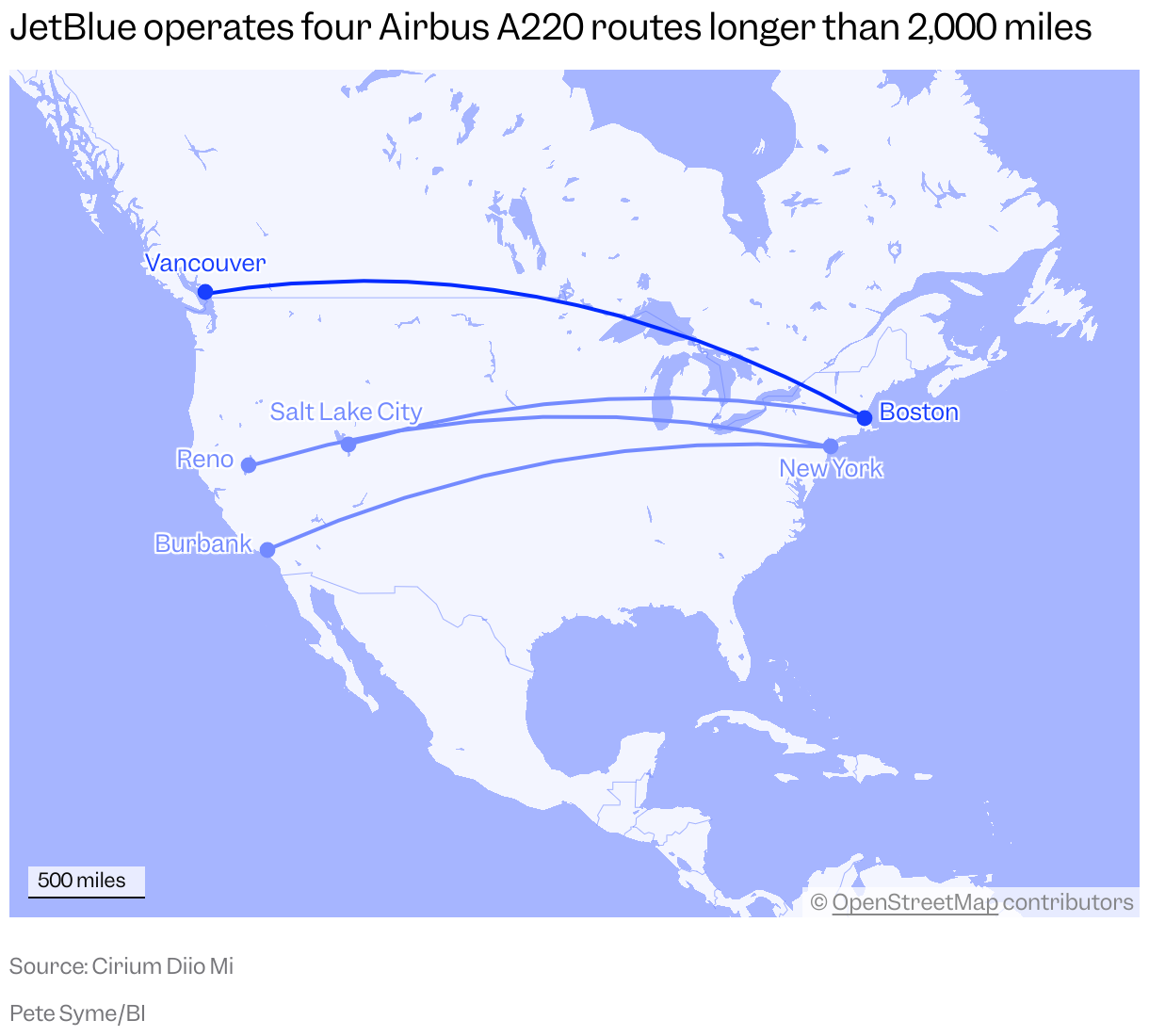
In June, JetBlue also began operating the A220 on flights between Boston and Vancouver — its longest route yet at roughly 2,500 miles.

Along with Delta Air Lines and Breeze Airways, JetBlue is one of just three US airlines to use the A220.

Here’s what it’s like on board, and how duties imposed during the first Trump administration partially led to Airbus taking over the jet program for just 1 Canadian dollar.

Airbus exhibited a JetBlue A220 at June’s Paris Air Show.
A JetBlue Airbus A220 viewed from the side near the front, at the 2025 Paris Air Show

The 3,800-mile range is enough to fly transatlantic, but such routes are usually popular enough that airlines want more seats.

Its competitors include the smallest variation of the Boeing 737 and Embraer’s E195-E2.

The same month, JetBlue began its longest route using an A220 — between Boston and Vancouver.

Vancouver and Boston are about 2,500 miles apart, and the flight can take up to six hours. JetBlue previously operated this route until last September using the larger Airbus A321.

According to data from the aviation analytics firm Cirium, this is also the fifth-longest A220 route in the world. The title belongs to Air Baltic’s 2,684-mile journey between Dubai and Latvia.

A splash of colour and the airline’s logo made boarding feel more welcoming than a barebones plane.
The JetBlue logo displayed in the interior of an Airbus A220 next to the bathroom

Blue lighting throughout the cabin also added to the atmosphere on board. JetBlue says the custom mood lighting changes through the day.

With a more spacious cabin than competing aircraft, the A220 is configured in a rare 2-3 layout.
A view down the aisle of a JetBlue Airbus A220

Cabins like this used to be more common on old airplanes like those made by McDonnell Douglas, which merged with Boeing in 1997. There are fewer than 100 Boeing 717s still in service, a jet which was originally known as the MD-95.

Other than the A220, Russia’s Superjet 100 is the only jet still being built with a 2-3 layout.

And yet, the seats are still quite large.
A row of three economy seats on board a JetBlue Airbus A220

JetBlue says the A220 has the widest coach seats of any single-aisle aircraft, measuring 18 inches. 

Couples or solo travelers might also like the fact that there are fewer middle seats.
A row of two economy seats on board a JetBlue Airbus A220

These seats are half an inch narrower than the 18-inch seats found in the groups of three.

The first four rows are dedicated to premium seats.
A row of premium seats at the front of a JetBlue Airbus A220

In addition to up to seven inches of extra legroom, “EvenMore” comes with early boarding, free alcoholic drinks, and priority security at some airports.

There are also another couple of rows by the overwing emergency exits, for a total of 30 premium seats.

The relatively large cabin also means there’s plenty of overhead bin space — with more improvements on the way.
The overhead bins on a JetBlue Airbus A220

Airbus says its coming “Airspace” cabin would have enough bin space for every A220 passenger to store a carry-on.

The coach seats offered fairly generous legroom.
A first-person view of the legroom in economy class on a JetBlue Airbus A220

The pitch, which is the distance between the same spot on one seat and the one in front, is 32 inches. That’s typically among the most you can find in economy.

I was also impressed by JetBlue’s in-flight entertainment system.
A close-up of the entertainment screen on board JetBlue Airbus A220

JetBlue also offers free WiFi, and its A220s have USB-C, USB-A, and AC power for charging.

It also has live TV on all of its planes, although this type has only 18 channels compared to over 100 on its A321s. Delta only has live TV on select planes, excluding its A220s.

Two bathrooms at the rear were also more spacious than I expected.
Two bathrooms at the rear of a JetBlue Airbus A220

Most regional planes, like the Embraer 190, have one bathroom at the back, which can feel a bit cramped.

The A220 was first built by Bombardier, but Airbus bought the program for 1 Canadian dollar.
The new bombardier aircraft CSseries is shown in Mirabel, Quebec as it is due to take off for the first time on September 16, 2013.
A Bombardier CSeries outside the factory in Quebec in 2013.

Before it was the A220, it began as Bombardier’s CSeries program, which launched in 2008. The plane entered service in 2016.

It was already facing financial difficulties due to overspending, development delays, and stiff competition with the Boeing 737-700.

Then, in 2017, Boeing accused Bombardier of unfairly trying to increase its market share by selling dozens to Delta for less than their production cost, a practice known as dumping.

The US government then imposed duties totaling 292%. It said around 80% was due to the dumping petition and the rest due to subsidies by the Canadian government.

Bombardier rejected the allegations at the time and said: “The magnitude of the proposed duty is absurd and divorced from the reality about the financing of multibillion-dollar aircraft programs.”

In October, Airbus paid 1 Canadian dollar to take a controlling stake in the program in 2017, renaming it the A220 a year later. It also agreed to build many of the planes at its production line in Mobile, Alabama.

Since Donald Trump announced his tariff plan, trade deals with the UK, European Union, and Brazil have included exemptions for planes.

Read the original article on Business Insider

Spread the love
Categories
Selected Articles

Tensions soar in Serbia as protesters clash with police

Spread the love

Police threw multiple rounds of tear gas and charged at the demonstrators who hurled bottles, rocks and flares at them.

Spread the love
Categories
Selected Articles

Oasis pay tribute to Irish roots in sell-out Croke Park reunion gig

Spread the love

The Britpop band will play two sold-out gigs at Croke Park.

Spread the love
Categories
Selected Articles

How Gen Zers are landing roles in tech

Spread the love

split screen, gen z grads
Gen Zers Kanika Mohan and Charley Kim landed tech jobs after graduation.

  • Gen Zers who aspire to work in tech are up against a frozen job market.
  • Some successfully landed tech roles, and others are hoping to pivot.
  • Networking and tailored applications are crucial for standing out in a competitive market.

Kanika Mohan thought she’d have a job after graduation — and hopefully it would come with three meals and laundry service.

The 21-year-old studied computer science, had a slate of summer internships at top tech companies, and regularly attended campus career fairs. A first-generation college student, the 2025 grad felt STEM was the surefire path to corporate success.

“I love building things and computer science was a pretty hot topic over social media,” Mohan said. The jobs were cushy, with all kinds of perks. “It was just insane to think about,” she added. “I never saw my parents have any of those jobs. My parents worked regular, non-corporate, blue-collar jobs.”

Frustrated by a monthslong job hunt, Mohan began looking outside Big Tech. She said she applied for business analyst and marketing roles at airlines, banks, and consumer companies, and any other opportunity she could find in her skillset. She was eventually hired by a major tech company, but she’s glad that she broadened her search.

Mohan’s experience is increasingly common. Jobs in computer science and tech have long been advertised as a path to lucrative salaries and luxurious office perks. But, with AI and widespread corporate cost-cutting contributing to a white-collar hiring slowdown, the industry is hemorrhaging entry-level opportunities.

The tech job market is not just rough for newcomers. Daniel Zhao, chief economist at Glassdoor, wrote in a new blog post that the US tech industry seems to be in an employment recession because it mirrors the Great Recession. US job postings for tech workers on job-search platform Indeed have cooled more than overall postings from Great Resignation peaks. However, some more experienced job seekers may fare better if they have the skills needed in the growing AI talent war.

As doors close across the industry, tech grads are having to rethink their dream roles. BI spoke with Gen Zers and labor market experts to understand the challenges young tech aspirants are facing — and potential solutions.

‘Chances are you won’t get a job at Microsoft’

After landing her role, Mohan now teaches other 20-somethings on TikTok about how to break into the tech industry.

“One thing I realized is that a lot of people have a dream company or a dream role,” she said. “But it’s really tough to do that anymore. You can’t just be like, ‘I want to work at Microsoft, so I’m only going to apply to Microsoft.’ Chances are you won’t get a job at Microsoft.”

Economists said this is a smart strategy. The number of computer and information sciences grads has increased in recent years, so holders of those degrees face more competition for a shrinking number of openings. AI is also shifting what entry-level work looks like in those fields, and companies are looking for ways to cut costs and streamline their workforce.

Zhao, the Glassdoor economist, told Business Insider that many tech employers have been slow to hire entry-level workers. A Burning Glass Institute report showed that the unemployment rate for Gen Zers and younger millennials in computer and math occupations has recently increased from before the pandemic, meaning recent graduates could be up against others competing for similar roles.

“It’s no surprise that new graduates in computer science and engineering have had a tough time getting their foot in the door,” Zhao said.

It’s part of why Gen Zers like Timothy Innamorato are considering pivoting. He wanted to work in tech, but he’s also been applying for grocery store and janitorial jobs.

Since completing a certification program in computer science and information technology last year, 27-year-old Innamorato has sent out a few hundred job applications, he said, and has landed around eight interviews in his field.

“I’ve been shifting my views on whether or not I even want to continue looking at the moment, especially with the AI thing that’s happening now,” he said.

He’s also gotten a few interviews for grocery store jobs, which he’s been applying to because he needs something to keep him afloat. He’s had some success getting callbacks when he applies to custodial positions in his local school district.

“Everybody now is shifting over to the idea of going to do trades, so being a plumber or doing HVAC or being an electrician. Honestly, that doesn’t sound like a bad thing, it’s just that you got to be on your feet a lot more and you got to go to people’s houses and crawl in attics,” he said. “It’s not the same as IT. But I mean, I don’t know.”

How to stand out in the application ‘numbers game’

Charley Kim, 23, recently landed a software engineering role at a Big Tech company. He said he’s lucky — he graduated in 2024 with a computer science degree and knows several friends who are still looking for work.

“There are just so many people applying to the jobs, and there’s only a limited number of jobs out there,” Kim said, adding, “Getting an interview is probably harder than the interviews themselves.”

Though Kim said that the job hunt can feel like a random “numbers game,” he thinks the effort he put into networking paid off. Not only did talking to people already in the tech industry help him hone his application, he said it allowed him to get the referrals he needed to make his résumé stand out from the pile.

Christine Cruzvergara, chief education strategy officer at Handshake, said it’s important to build a community because job searching can be time-consuming and emotionally taxing. As Mohan put it, the post-grad job search can feel “really scary, really harsh, and really painful.”

Cruzvergara said your community can include friends, advisors, or whoever can help you feel better and give you real feedback during job hunting.

Cruzvergara also suggested not filling out hundreds of applications and instead making sure you’re putting enough time into checking out the company, including whether it seems like a good fit.

Mass applying is actually hurting people because they’re putting in lower-quality applications that aren’t going to stand up in a competitive applicant pool,” Bonnie Dilber, a recruiter at a software company, previously told Business Insider.

Natasha Pillay-Bemath, vice president of global talent acquisition and executive search at IBM, said there will continue to be demand for entry-level talent, especially in “more critical, complex spaces of tech like AI and cloud.” Strong applicants should show that they can both master using AI and also lean on soft skills like creativity and effective communication, she said, as AI takes away the “rote work” of an entry-level hire.

Mohan said she had a few different versions of her résumé and cover letter depending on the types of roles she was applying for. Putting her experience and interests on paper — and occasionally using AI to optimize for specific positions — helped her build confidence.

“Building my résumé early on helped me also realize that I know I can switch industries,” she said. “I realized what industry I like and what roles I like because there’s so, so many different things you can do. You won’t know that unless you actually try.”

Read the original article on Business Insider

Spread the love
Categories
Selected Articles

Magnitude 5.8 earthquake rocks Indonesia’s Sulawesi island

Spread the love

The quake was followed by at least 15 aftershocks. Local authorities say they’re conducting rapid assessments to determine the initial impact of the earthquake.

Spread the love
Categories
Selected Articles

European leaders from ‘coalition of the willing’ to hold conference call over Trump-Putin meeting

Spread the love

Leaders set to meet to try to protect peace deal after Putin demands Ukraine withdraws from Donetsk and Luhansk

Welcome back to our live coverage of Russia’s war on Ukraine.

While Washington prepares to welcome Volodymyr Zelenskyy for crunch talks with Donald Trump on Monday, European leaders who make up the so-called “coalition of the willing”, a loose partnership of western countries pledging support for Ukraine, are set to hold a conference call on Sunday to try to protect a peace deal that does not reward Russia for its aggression.

President Trump’s efforts have brought us closer than ever before to ending Russia’s illegal war in Ukraine. His leadership in pursuit of an end to the killing should be commended.

While progress has been made, the next steps must be further talks involving President Zelenskyy. The path to peace in Ukraine cannot be decided without him.

Continue reading…


Spread the love