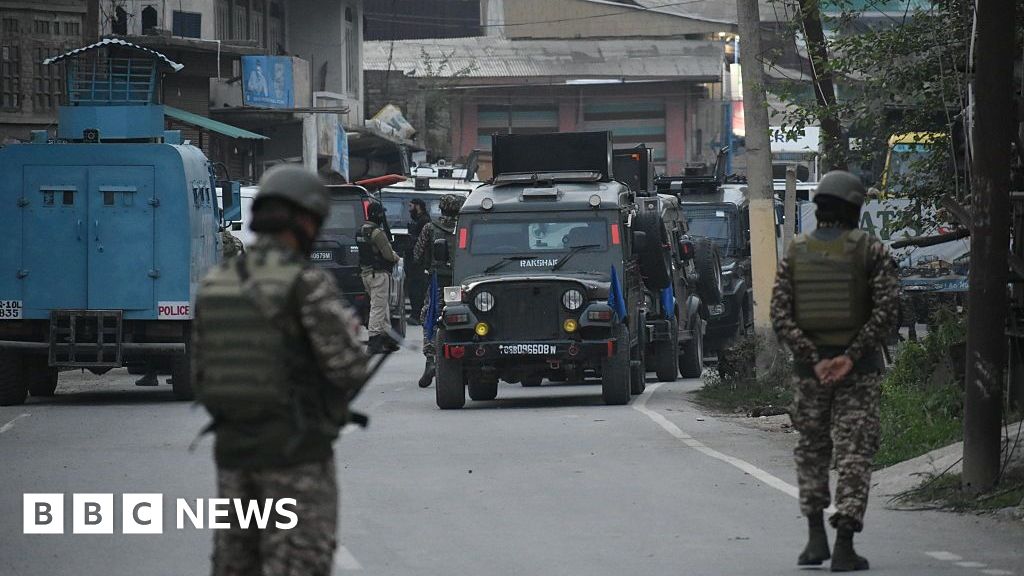
India launched strikes in the early hours of Wednesday – two weeks after a deadly militant attack.
 Capitol Riot - capitol-riot.com
https://t.co/dOEIejESjI
Doug Mills photo cannot be a proof of the AK-47 bullet path.#NewsAndTimes #NT #TNT #News #Times #World #USA #POTUS #DOJ #FBI #CIA #DIA #DOD #ODNI #Trump #TrumpNews #TRUMPISTAN #Israel #Mossad #Netanyahu #Ukraine #NewAbwehr #OSINT #Putin #Russia #GRU… https://t.co/nulcmK8j08 pic.twitter.com/KGaBSyg7Xp— Michael Novakhov (@mikenov) May 7, 2025
The Trump administration is determined to create still greater and graver instability in the United States’ relationships with other countries. It will add yet more stress to the already highly volatile currency markets, while further damaging the prospects for the world’s poorest countries.
The “America First” doctrine vs. multilateralism
We may well be seeing the smashing of the compact reached in Bretton Woods, New Hampshire, at the Mount Washington Hotel back in 1944. Representatives of 44 allied nations met under U.S. and U.K. leadership to establish multilateral economic institutions to ensure that the post-Second World War world would be guided by a true spirit of partnership, cooperation and goodwill.
The first salvo in the Trump Administration’s strategy to dominate and dictate international economic relations came in early April with massive, across-the-board trade tariffs.
The second salvo that is now being fired by the U.S. Treasury and the U.S. Office of Management and Budget (OMB) has the IMF, the World Bank and all aid programs as its targets. Just like with tariffs, so on this front, Trump’s doctrine of “America First” is being pummeled into the multilateral institutions.
Dictating to the IMF
While Trump’s Treasury Secretary, Scott Bessent, recently declared that the Administration wants to strengthen both institutions, he stressed: “America First seeks to expand U.S. leadership in international institutions like the IMF and World Bank.”
Broadly speaking, this means robust U.S. Treasury action to force the IMF to bow to its demands. Specifically, it means supporting governments that President Trump likes and getting very tough on all others.
IMF lending to Argentina dwarfs total lending to all of Africa
Trump’s favorite national leader in the Western Hemisphere is Argentina’s Javier Gerardo Milei. He recently received a visit from Treasury Secretary Bessent just as the IMF announced it is providing a further $20 billion line of credit to Milei’s government, adding to the more than $30 billion the country already owes the Fund.
IMF lending to Argentina dwarfs total lending to all of Africa. The only African country that has secured major IMF lending, amounting to over $8 billion, and is likely to continue to do so, is headed by the man Trump once called “my favorite dictator” – Egypt’s Field Marshal Abdel Fattah el-Sisi.
Forcing reforms
As the largest shareholder in the IMF and the World Bank, the United States holds veto powers over major policy decisions. In practice, “America First” means that the United States will see to it that China’s influence is reduced, while the IMF’s economists are pressed to publicly rebuke China’s economic and trading policies.
In budget terms, “America First” means that the United States will seek to sharply cut the budgets and staffing at both the IMF and the World Bank.
After all, Bessent also noted recently that the two institutions are bloated, inefficient and have veered greatly from their core missions. For example, he scolded the IMF, asserting: “Now it devotes disproportionate time and resources to work on climate change, gender and social issues.”
No more anti-corruption activities?
Given the explicit opposition by Trump to domestic U.S. investigations and prosecutions of corruption and money laundering, one has to worry that the U.S. government will move to oppose the IMF’s and World Bank’s efforts to make anti-corruption policy a critical priority.
Underscoring the U.S. Administration’s opposition to all forms of international anti-corruption action, Trump’s Office of Management and Budget has announced that it is cutting all funding for the National Endowment for Democracy. The NED has been a leading supporter of anti-kleptocracy, pro-democracy civil society organizations and independent journalism across the developing world.
Cutting aid for the poorest
The “America First” approach will have a long-term devastating impact on the poorest nations of the world and on the fundamental World Bank goal of reducing poverty.
In mid-April, finance ministers from developing countries asserted at their Washington meeting of the Group of 24: “We call for IDA’s timely effectiveness and operationalization.” The White House ignored the call. The opposite is now likely.
The Biden Administration had pledged $4 billion to support funding for the next three years for the International Development Association (IDA), the World Bank’s affiliate that is the single largest source of aid to the poorest countries and aims to produce benefits for over 1.9 billion people.
Trump’s OMB has just informed Congress that it is limiting the U.S. contribution to IDA to $3.2 billion, stressing that “other donors and institutions should take on more of the burden sharing.”
In fact, some other major donors may follow the U.S. lead. For example, the UK’s Save the Children organization has stated that it is deeply concerned that the UK will reduce its contribution as its shifts aid funds to boost its own outlays on defense.
Next on the chopping table: The UN
U.S. cuts in funding for IDA are just a small part of the overall White House war on humanitarian aid. OMB in its preliminary budget-cutting plan has announced
ending U.S. funding for the grant window of the African Development Bank, ending support for the Inter-American Foundation, U.S. African Development Foundation, almost all operations of the U.S. Agency for International Development, while sharply cutting support for the World Food Program.
Further, the White House announced that its: “Budget pauses most assessed and all voluntary contributions to UN and other international organizations, including for the UN Regular Budget, UN Educational, Scientific and Cultural Organization and the World Health Organization.”
And the White House added: “The Budget does not provide funding for wasteful United Nations (UN) and other peacekeeping missions due to recent failures and high level of assessments.”
Conclusion
The list of White House announcements to cut many existing international humanitarian programs, and many long-standing commitments to international organizations, including many in the UN family, underscores a core retreat from multilateral engagements.
It is clear that this U.S. Administration has a simple view: International economic and anti-poverty organizations either bow to “American First” approaches, or they cease to obtain U.S. government support.
Faced with this challenge, it is imperative that the other major shareholders and financial supporters in the Bretton Woods organizations and other multilateral official agencies, raise their voices in support of cooperation and partnership.
To go along with the Trump policies now is to give up on a consensus forged over 80 years ago that has been absolutely crucial in contributing to the formidable economic development of scores of nations and billions of people.
To be sure the world has major humanitarian challenges, yet it would be profoundly wrong to ignore the progress over the last eight decades, and to believe that the crises of today can be resolved via U.S. bombast and unilateralism.
The post Destroying the U.S.’s Last Global Bridges? appeared first on The Globalist.
#FBI FBI
While high-speed photography can be used in forensic ballistics to capture bullet trajectories, specific court case examples using this technique for AK-47 bullet paths are not readily available in general search results.
M.N.: This makes it much harder to identify the… pic.twitter.com/BS7hnLkD3G— Michael Novakhov (@mikenov) May 7, 2025